Titan News 2012
December 13, 2012: A Recent Image of the Ligeia Mare Area Unveils a Big River System Reminiscent of the Nile River
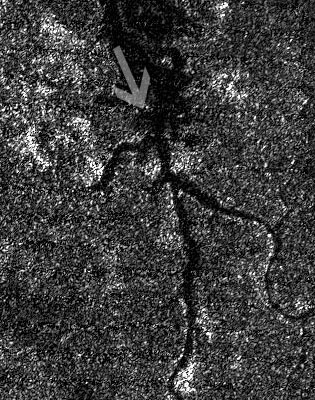
A Radar image of Titan obtained with the Radar Mapper of the Cassini spacecraft on September 26, 2012, during the 87th close flyby of Saturn's largest moon reveals a giant river system or a network of channels reminiscent of the famous Nile River, in the high latitudes of the northern hemisphere of Titan. This well-defined river system, identified with a relatively high resolution, feeds the second largest body of liquids in the north polar region Ligeia Mare.
The river system stretches more than 200 miles or 400 kilometers. The dark and uniform appearance of the presumed river system and of Ligeia Mare suggests that those landscape features are currently filled with liquids.
The lakes, seas and rivers of the high latitudes of the northern hemisphere may consist of a mixture of methane and ethane. Propane and dissolved nitrogen may also be present in the presumed rivers, lakes and seas. Ethane had already been identified in the south polar lake Ontario Lacus, in 2008, with the Visual and Infrared Mapping Spectrometer of the Cassini probe.
The dark river valley running toward the presumed lake Ligeia Mare is not particularly sinuous and is relatively straight which implies that it follows the trace of at least one fault or topographic fracture. Such faults or fractures in bedrock may engender the opening of basins or even the formation of the big lakes or giant seas such as Kraken Mare in the high latitudes of the northern hemisphere.
The radar-dark appearance of the channels is consistent with the radar signature of liquids which have a relatively low albedo. Moreover, no significant brightness variations can be noticed inside the dark channels or valleys and inside the area of Ligeia Mare. The relative uniformity of Ligeia Mare and of the dark channels strengthens the hypothesis that those areas are currently filled with liquid hydrocarbons.
Jani Radebaugh, a Cassini radar team associate at Brigham Young University, Provo, Utah pointed out: "Though there are some short, local meanders, the relative straightness of the river valley suggests it follows the trace of at least one fault, similar to other large rivers running into the southern margin of this same Titan sea." She advanced: "Such faults - fractures in Titan's bedrock - may not imply plate tectonics, like on Earth, but still lead to the opening of basins and perhaps to the formation of the giant seas themselves."
Surprisingly, the bodies of liquids are mostly concentrated in the polar regions or in the high latitudes of the Orange Moon. The equatorial and tropical regions such as Shangri-La or Fensal/Aztlan tend to be dominated by Seif dunes or dunes extending over long distances. The infrared or near-infrared images of the low latitudes, obtained with the VIMS instrument of the Cassini probe unveil a significant brightness contrast between relatively dark regions such as Shangri-La and relatively bright regions such as Adiri.
The dune fields can be found in the darker areas such as Shangri-La and Fensal/Aztlan. Is the current relative dryness of the low latitudes related to seasonal factors ? Monsoon events or periodic storms may occur in the low latitudes of the moon with the formation of transient, massive cloud systems.
The Spring Equinox in the northern hemisphere occured in August 2009 and some seasonal changes have been clearly observed since 2009. In late 2010, large, dynamic and transient cloud formations were imaged with visible-light cameras of the Cassini probe in the low latitudes of the Opaque Moon. Images taken after the storm observed unveiled a darkening of low-latitude areas. This may have been related to a recent rainfall.
The observations from the Huygens probe during its atmospheric descent on January 14, 2005 had clearly shown dark channels in the hills of the bright Adiri. Those channels may correspond to fractures or drainage channels. This is a significant clue to the existence of seasonal rainfalls in the low latitudes of Titan.
Steve Wall, the radar deputy team lead, based at NASA's Jet Propulsion Laboratory, Pasadena, California advanced: "Titan is the only place we've found besides Earth that has a liquid in continuous movement on its surface."... He added: "This picture gives us a snapshot of a world in motion. Rain falls, and rivers move that rain to lakes and seas, where evaporation starts the cycle all over again. On Earth, the liquid is water; on Titan, it's methane; but on both it affects most everything that happens."
The river system observed with the Radar Mapper on September 26, 2012 shows some similarities with the Nile River which stretches approximately 4,100 miles or 6,700 kilometers but the river running into Ligeia Mare is only a little bit longer than 200 miles or 400 kilometers. The shape of the presumed Titanian river may be closely related to faulting or topographic fractures as is the case for the formation of the Nile River which appears to be the longest river on the Blue Planet. The fractures or faults account for the sinuosity of the river or for the nearly right-angle changes in the direction of the drainage channel.
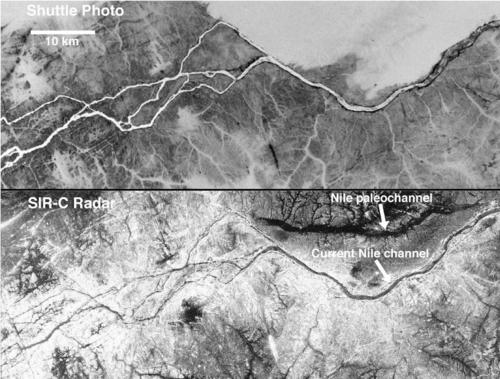
A radar image of a portion of the Nile River, near the Fourth Cataract in Sudan obtained by Spaceborne Imaging Radar C/X-Band Synthetic Aperture Radar (SIR-C/X-SAR) aboard Space Shuttle Endeavour in April 1994 as well as a gray scale view originally captured with color infrared film from Space Shuttle Columbia in November 1995 allow us to draw a parallel between the Nile River and the well-defined river network connected to Ligeia Mare. The radar view also shows an older channel buried in drifting sands with a branching network whose appearance is very close to several north polar river networks on Titan.
|
|
|
|
| The radar portion in the upper part of the table, taken
from the Radar Mapper of the Cassini spacecraft on September 26, 2012
during the 87th flyby of Saturn's largest moon, shows a dark drainage
channel connected to the southern part of the famous north polar lake
Ligeia Mare. This presumed river, which is not particularly sinuous,
shows some similarities to the Nile River, the longest river on Earth. The lower view of the table corresponds to a mosaic revealing a portion of the Nile River, near the Fourth Cataract in Sudan. The top view of the mosaic was obtained in November 1995 from Space Shuttle Columbia with color infrared film. The lower view of the mosaic corresponds to a radar image of the same area acquired from Space Shuttle Endeavour in April 1994 with Spaceborne Imaging Radar C/X-Band Synthetic Aperture Radar (SIR-C/X-SAR). The radar view unveils the current channel of the Nile as well as an older river network buried in drifting sands.
Radar Image Credit Upper View:
NASA/JPL-Caltech/ASI. |

|
|
|
|
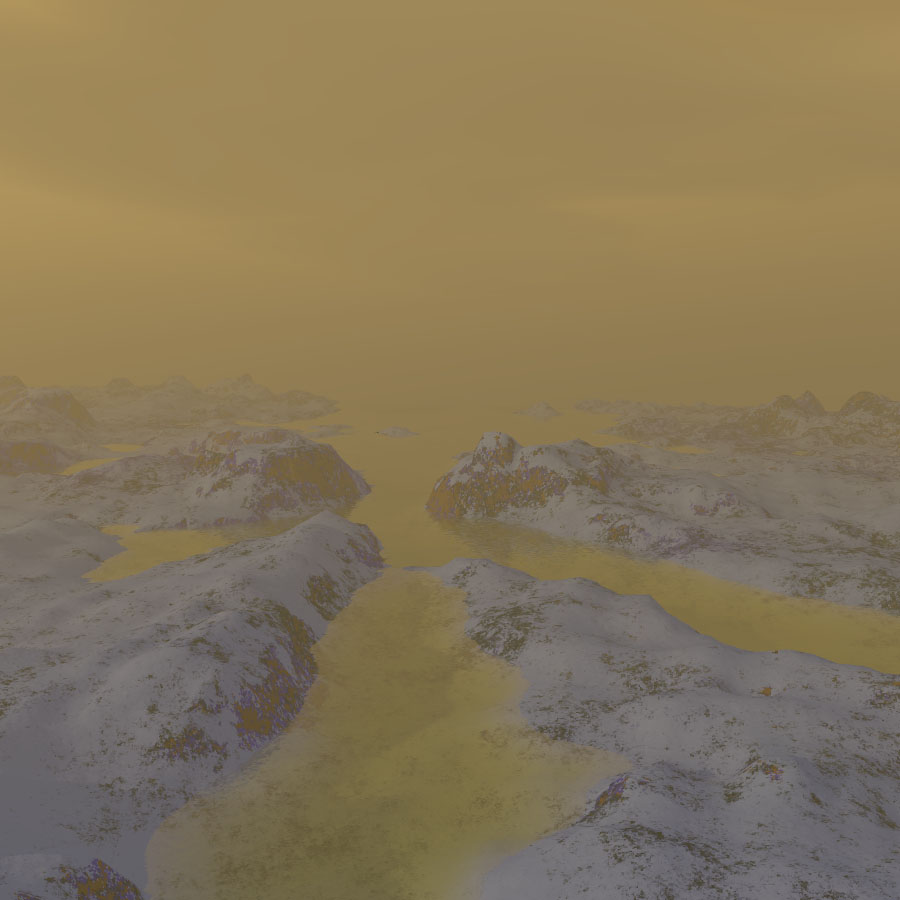
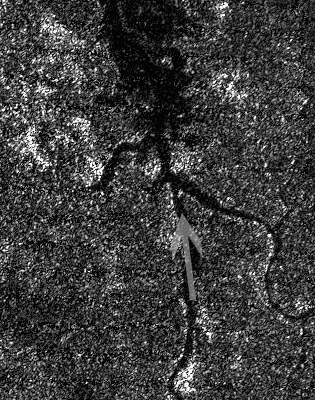
| The upper view of the table corresponds to an artist's
impression of a river fueling the north polar lake Ligeia Mare. The
computer-generated image is based on a radar portion of the radar image
obtained with the Radar Mapper of the Cassini probe on September 26,
2012. The radar image in the lower part of the table shows the southern
part of Ligeia Mare as well as the dark drainage channel fueling the
lake. The dark drainage channel resembles the well-known Nile River. A
gray arrow was incorporated by Marc Lafferre into the original radar
image to indicate the orientation of the virtual camera in the artist's
rendering. The southern portion of Ligeia Mare can be clearly identified
on the horizon, in particular. The "crossroad" between several river
branches can be clearly observed as well.
© Artist's Impression:
Marc Lafferre, 2012. |
|
|
|
|
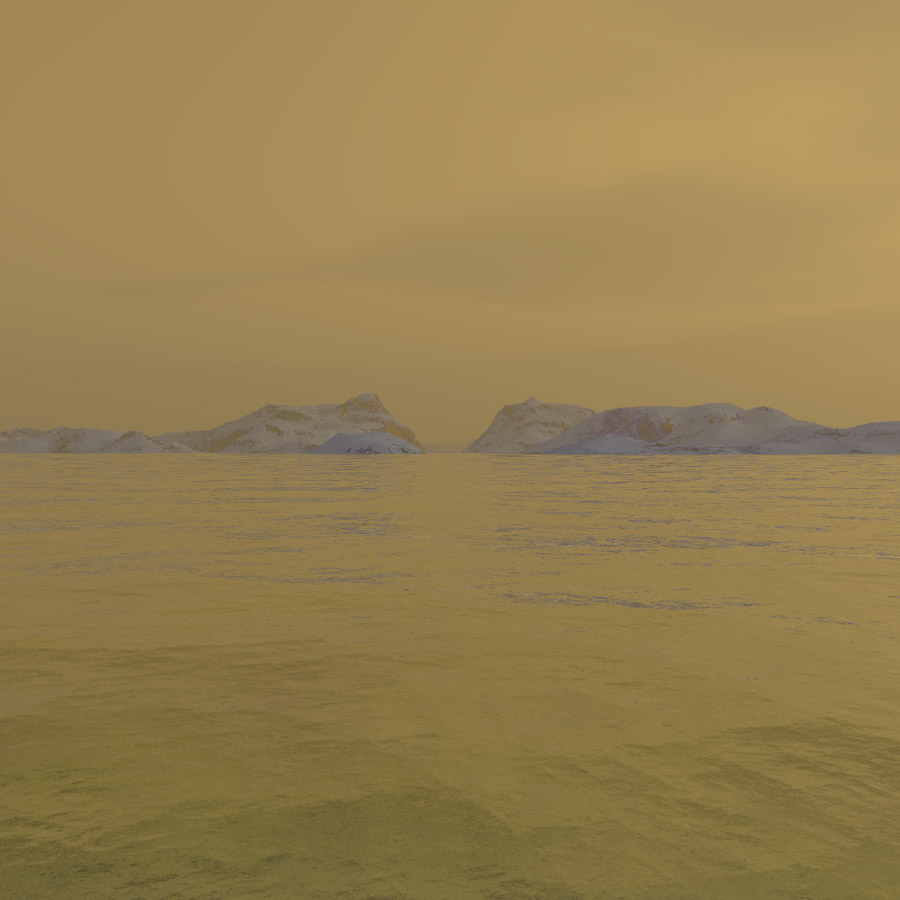
| The upper view of the table represents an artist's
impression of the southern part of the north polar lake Ligeia Mare. The
computer-generated image is based on a radar portion of the radar view
obtained with the Radar Mapper of the Cassini spacecraft on September
26, 2012. The radar image in the lower part of the table unveils the
southern part of Ligeia Mare as well as the dark drainage channel
fueling the lake. A gray arrow was inserted by Marc Lafferre into the
original radar image to indicate the orientation of the virtual camera
in the artist's rendering. In the artist's impression, one can observe,
notably, on the horizon two prominent mountains located at the
intersection between the river system and the southern part of Ligeia
Mare. To a certain extent, those topographic obstacles characterize a
strait comparable to the Strait of Gibraltar between the Atlantic Ocean and
the Mediterranean Sea.
© Artist's Impression:
Marc Lafferre, 2012. |
- To get further information on that news, go to: http://saturn.jpl.nasa.gov/news/newsreleases/newsrelease20121212.
December 6, 2012: A New Study Suggests that Titan May Be Icier than Previously Thought
A new model proposed by Howard Zebker, a professor of geophysics and of electrical engineering at Stanford University provides us with a new assessment on the internal structure of Saturn's largest moon Titan and reveals that the external icy crust is twice as thick as previously believed. The findings of the study will be presented at the annual meeting of the American Geophysical Union (AGU) in San Francisco.
Howard Zebker determined his estimate of the internal structure of the Orange Moon on the basis of topographic data and gravity data. The Radar instrument of the Cassini probe which has been exploring the Saturn System since mid-2004 allows scientists to identify surface features such as mountains, hills, plateaus, lakes, seas, rivers, volcanoes or craters.
The data obtained from the Cassini spacecraft are consistent with the presence of several layers of materials from the center of the moon to the soil. In other words, Titan may not have a uniform composition and may be a differentiated body. Many scientists have postulated the presence of a liquid water ocean beneath the icy crust of the Orange Moon.
The new study suggests the presence of a core made of ice and rock, of an outer icy crust and of a layer of liquids between the core and the external crust. This outcome is based on a combination of improved radar measurements of the landscape with newly released gravity measurements.
The heat generated in the interior may partly depend on the composition of the core. The higher the concentration of radioactive elements in the core, the higher the amount of energy it will generate, contributing to keep the presumed internal ocean from freezing solid.
However, the authors of the study suggest that the presence of the underground ocean is closely related to the gravitational interactions between Titan, Saturn and the other moons of the Gas Giant. The influence of the gravitational forces of the other neighboring bodies on the internal dynamics of the Orange Moon may be higher than previously thought.
Titan may be a cousin of the Earth in terms of internal dynamics but the equivalent of the magma of the Blue Planet may be a subsurface ocean of water likely to harbour a typical lifeform based on water molecules and carbon.
Howard Zebker pointed out: "Titan probably has a core that is a mixture of ice and rock." The radioactive elements suspected to be present in the core and resulting from the formation of the Solar System will decay over time and produce heat at the same time. This energy emanating from the core contributes to prevent the internal ocean from freezing solid.
Saturn exerts the strongest gravitational force around Titan. The variations in the distance of Titan from Saturn engender changes in the level of tidal forces. The orbit of Titan around Saturn is, indeed, slightly elliptical. The moon which is orbiting Saturn at a mean distance of 1,221,870 km appears to be tidally locked to Saturn which means that Titan always shows the same portion of the globe towards Saturn and that a revolution around Saturn takes the same time as a full rotation of Titan. As a result, a Titanian day lasts about 16 days which corresponds to the time it takes for the moon to perform a full revolution around the Gas Giant.
The gravity instrument of the Cassini spacecraft can measure, on the basis of the spin, the resistance of the Opaque Moon to any changes in its spin, also called the moment of inertia. Howard Zebker explained: "The moment of inertia depends essentially on the thickness of the layers of material within Titan."
On that basis, Howard Zebker and his graduate students were in a position to use that data to calculate the internal structure of Saturn's largest moon. Howard Zebker argued: "The picture of Titan that we get has an icy, rocky core with a radius of a little over 2,000 kilometers, an ocean somewhere in the range of 225 to 300 kilometers thick and an ice layer that is 200 kilometers thick."
The composition of the Titanian core is likely to have a strong impact on the size of the internal ocean and on the thickness of the icy crust. A previous model of Titan's internal structure had postulated an icy crust of about 100 kilometers thick. In the new model proposed by Howard Zebker, the outer icy crust is twice as thick as in the previous prevailing model.
If the core contains a higher concentration of ice and a lower concentration of rocks, the energy engendered from the radioactive decay of radioactive elements in the rocks will be weaker and the radioactive elements won't bring enough energy upwards to sustain a larger layer of liquid water beneath the icy crust.
The gravitational forces exerted by the celestial bodies of the Saturn System tend to distort the shape of Titan which appears oblong along its equator and a little flattened or squashed at the poles.
On the basis of measurements of the observed gravitational field of the Orange Moon, one can notice that Titan is much more distorted than would be predicted by a basic gravitational model. A constant average density from the core to the surface may be expected on the basis of the observed gravitational pull. This hypothesis is ruled out because the density of the compounds under the poles must be slightly greater than it is under the equator.
Howard Zebker anticipated that the ice layer must be a little bit thinner at the poles than at the equator and, in parallel, the water layer must be a little bit thicker at the poles. The higher amount of liquid water beneath the polar area compared to the amount of liquid water beneath the equatorial area tends to strengthen the gravity near the poles because liquid water is denser than ice.
The scientists of the team calculated that the icy crust is approximately 3,000 meters thinner than average at the poles and 3,000 meters thicker than average at the equator. The average thickness of the icy layers, representing approximately 200 km, was determined on the basis of the combination of gravity and topography data.
The variations in the depth or the shape of the internal layers appear to be related to variations in the heat distribution. The heat emanating from the core is likely diffused uniformly toward the surface. The variation in ice thickness may primarily result from the variations in the distance of Titan from Saturn during its orbital journey around Saturn. Let's recall that the orbit of Titan around Saturn is not perfectly circular and is slightly elliptical.
Howard Zebker advanced: "The variation in the shape of the orbit, along with Titan's slightly distorted shape, means that there is some flexure within the moon as it orbits Saturn." The variations in the tidal forces generated by Saturn are much more important than the variations in the tidal forces generated by the other moons of Saturn. Howard Zebker pointed out: "The tides move around a little as Titan orbits and if you move anything, you generate a little bit of heat."
It turns out that the tidal interactions tend to be more concentrated at the level of the polar areas than at the level of the equatorial regions. That implies that there is more heat produced at the poles and that there is more ice turned into liquid at the bottom of the ice layer. Therefore, the icy crust appears thinner in the polar region than below the equatorial region and the subsurface ocean is deeper beneath the polar region than beneath the equatorial region.
The theoretical debate on the internal structure and composition of Titan goes on. The new model predicts a less deep subsurface ocean than previously believed. The assumed liquid layer located below the icy crust is likely composed of water but some scientists have suggested that it may be composed of a mixture of ammonia and water. Some scientists have also postulated the presence of a subsurface ocean of methane or ethane. Potential cryovolcanoes may provide us with significant clues on the nature of the interior or on the composition of the presumed subsurface ocean.
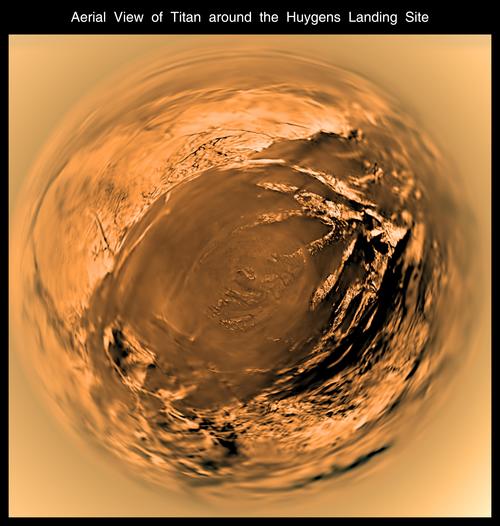
The image above is a stereographic or fish-eye projection of the Adiri/Shangri La region obtained with the Descent Imager/Spectral Radiometer of the Huygens spacecraft on January 14, 2005 when the probe was performing its atmospheric plunge towards the surface at an altitude of about 5 kilometers or 3 miles. The bright areas made of hills and showing dark drainage channels or fractures suggest the presence of water ice or frozen carbon dioxide on the ground. The dark areas may be rich in organics and hydrocarbons (such as methane or acetylene). Is there a subsurface ocean hidden beneath the crust ? Image Credit: ESA/NASA/JPL/University of Arizona.
- To get further information on that news, go to: http://news.stanford.edu/news/2012/december/titan-saturn-moon-120312.html.
November 29, 2012: Cassini Data Reveal Strong Seasonal Changes in the Characteristics of the Middle Atmosphere Over Titan's South Pole as well as the Development of Complex Molecules at High Altitudes
The instruments of the Cassini spacecraft, evolving in the Saturn System since mid-2004, are continuing to collect valuable data regarding the topography, the surface features and the atmosphere of Saturn's largest moon Titan.
The structure and the dynamics of Titan's atmosphere appear particularly complex with an apparent dichotomy between the meteorology of the polar regions and the meteorology of the equatorial and tropical regions. During the Summer period in the southern hemisphere and the Winter period in the northern hemisphere, the infrared or near-infrared data revealed that the cloud formations were mostly concentrated at high latitudes and a few cirrus-like clouds had been identified at mid-latitudes.
The radar data acquired from the Radar Mapper of the Cassini probe also showed that the bodies of liquids were mostly found at high latitudes or in the polar regions. Kraken Mare, Ligeia Mare and Punga Mare appear to be the largest pools of liquid hydrocarbons in the high latitudes of the northern hemisphere and Ontario Lacus appears to be the largest lake in the high latitudes of the southern hemisphere. The dark areas of the low latitudes turn out to be dominated by Seif Dunes or linear and parallel dunes extending over long distances.
Changes in the orbital parameters of the Orange Moon may engender significant seasonal changes or significant changes in the structure, composition or dynamics of the atmosphere. A Titanian year approximately lasts 29.5 Terrestrial years and a Titanian season lasts about 7 Terrestrial years. As a result, scientists need to perform an in-depth analysis of Titan's atmosphere for at least a full Titanian year in order to clearly understand the dynamics of Titan's climate or meteorology as well as the methane cycle.
The latest equinox occured in August 2009. The equinox marked the end of the Winter season and the beginning of the Spring season in the northern hemisphere and the end of the Summer season and the beginning of the Autumn season in the southern hemisphere. Since the equinox occured, dynamic and sporadic cloud systems have taken shape at low latitudes and a yellowish vortex developing over the south polar region has been recently observed from the Cassini spacecraft.
That's a clear sign that the atmospheric dynamics or that the meteorology are changing in the high latitudes of the southern hemisphere. Will the vortex bring rain ? Or will it engender new lakes or rivers as the Winter season approaches in the southern hemisphere ?
Climate models of Titan don't account for all the atmospheric phenomena, observed from the Cassini probe. A new study led by Nick Teanby who is based at the University of Bristol, England and who is a Cassini team associate reveals unexpected atmospheric phenomena related to seasonal changes such as the production of complex chemicals at particularly high altitudes over the south polar region.
Scientists are surprised to observe the development of trace gases over the south polar region implying that middle-atmosphere circulation must extend to an altitude of at least 600 kilometers (400 miles). That's an altitude which is higher than expected by scientists who believed that the top of the middle-atmosphere circulation was found at an altitude of 450 to 500 kilometers, where a layer of haze seems to be separated from the main haze deck. Thus, researchers can advance that the atmospheric circulation has an upper limit 60 miles or 100 kilometers higher than previously expected.
The paper of the study which appeared in the journal Nature on November 28, 2012 is entitled: "Active upper-atmosphere chemistry and dynamics from polar circulation reversal on Titan". The authors of the paper are Nicholas A. Teanby, Patrick G. J. Irwin, Conor A.Nixon, Remco de Kok, Sandrine Vinatier, Athena Coustenis, Elliot Sefton-Nash, Simon B. Calcutt and F. Michael Flasar.
Seasonal changes since the equinox of August 2009 have been clearly identified over the south polar region. Data obtained from the Cassini probe clearly show the atmospheric reversal between the north polar region and the south polar region. The decreasing amount of solar light related to the change in the relative position of Saturn's largest moon to the Sun engenders cooling effects with the air sinking over the south polar region. During the Summer season, by contrast, the air will tend to go up due to the increase in the amount of light received from the Sun.
Nick Teanby pointed out: "Cassini's up-close observations are likely the only ones we'll have in our lifetime of a transition like this in action."..."It's extremely exciting to see such rapid changes on a body that usually changes so slowly and has a 'year' that is the equivalent of nearly 30 Earth years."
Saturn's largest moon has always surprised scientists because the moon is covered with a deep, thick and opaque atmosphere which is more massive than the atmosphere of the Earth. The Huygens probe which landed into the Adiri/Shangri-La region on January 14, 2005 recorded a surface pressure of 1467 hPa. That's about 1.5 times higher than the atmospheric pressure on our planet at sea level.
There are some similarities between both atmospheres. The atmosphere of Titan is mostly composed of molecular nitrogen but the most abundant gas is methane and not oxygen. Hence, scientists can study the atmosphere of the Earth on the basis of natural laboratories such as the atmosphere of Titan, Mars, Venus or even Triton.
Scott Edgington, Cassini deputy project scientist at NASA's Jet Propulsion Laboratory, Pasadena, California advanced: "Understanding Titan's atmosphere gives us clues for understanding our own complex atmosphere."..."Some of the complexity in both places arises from the interplay of atmospheric circulation and chemistry."
The extent of the seasonal changes is closely related to the relatively high obliquity of Titan or to the relatively high inclination of the rotation axis of the moon to the normal of the orbital plane around the Sun. Scientists believe that the variations in the distance between the moon and the Sun during the revolution of Titan around the Sun partly account for the apparent dichotomy between the meteorology or climate of the north polar region and the meteorology or climate of the south polar region where the amount of surface liquids seems largely lower.
The data obtained from the Composite Infrared Spectrometer (CIRS), one of the instruments of the Cassini probe, unveiled, in particular, changes in hard-to-detect vertical winds and global circulation. The CIRS is well suited for analyses of high altitudes, of the atmospheric circulation, of the atmospheric chemistry, of changes in atmospheric temperature and of the distribution of gases like benzene (C6H6) and hydrogen cyanide (HCN).
Compression of the sinking air over the south polar region as it went down generated a hot spot hovering high above the surface of the south polar area. Is it likely to engender a stormy weather or cyclones with heavy showers or monsoon events ?
The Cassini scientists were in a position to determine an atmospheric circulation reversal to about six months around the August 2009 equinox. About two years after the equinox, some gases appear to have increased in abundance 100-fold. Most scientists didn't expect the increase to be so extreme.
Researchers have also been able to notice that the formation of a complex chemistry and vertical atmospheric movements are taking shape above the presumed detached haze layer. Thus, this haze layer may not be completely separated from the other layers of the atmosphere. Some experts suggest that in this haze layer, small haze particles may combine into bigger, but more transparent, clumped compounds that eventually fall to lower altitudes and give the Opaque Moon its characteristic orange appearance.
Mike Flasar, the CIRS principal investigator at NASA's Goddard Space Flight Center in Greenbelt, Maryland argued: "Next, we would expect to see the vortex over the south pole build up."..."As that happens, one question is whether the south winter pole will be the identical twin of the north winter pole, or will it have a distinct personality ? The most important thing is to be able to keep watching as these changes happen."
In parallel to the south polar vortex development, the north polar vortex or the giant ethane cloud identified above the south polar region a few years ago may progressively diminish in size or disappear as the Summer season approaches or develops in the northern hemisphere.
The authors of the paper suggest that the atmospheric circulation is closely related to the absorption of solar energy by the haze of the Summer hemisphere and to the winter-hemisphere cooling due to infrared emission by haze and trace gases. They deduce that these effects are significant well into the thermosphere, at altitudes higher than 500 kilometers above which high complexity compounds or ions develop.
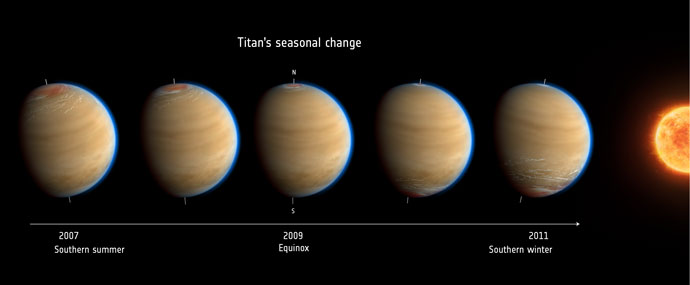
The artist's impression above, proposed by the European Space Agency, unveils the relative position of Titan's globe to the Sun from the Southern Summer in 2007 to the Southern Winter in 2011. One can notice that after the Equinox of August 2009, the north polar area is tilted toward the Sun. After the Equinox of August 2009, the amount of solar energy reaching the south polar region progressively decreases. One can observe the evolution of the blue detached haze layer found in the upper part of the atmosphere. A north polar hood appearing with a giant vortex made of ethane had been clearly identified during the Winter period of the northern hemisphere. This bright or white vortex was accompanied by a high-altitude "hot spot" appearing red as the artistic mosaic shows. After the Equinox of August 2009 and until 2011, trace gases were still developing over the north polar region and one could notice that the vortex and hot spot had nearly disappeared. In parallel, a yellowish vortex or a mass of swirling gas has been developing over the south polar region which is now experiencing the Autumn season. These atmospheric changes reveal what appears to be a large-scale reversal in the atmospheric circulation cycle from pole to pole immediately after equinox. An upwelling of gases can now be observed in the hemisphere approaching the Summer season and, in parallel, a downwelling of gases can be noticed in the hemisphere approaching the Winter season that is the Southern hemisphere. Image Credit: ESA.
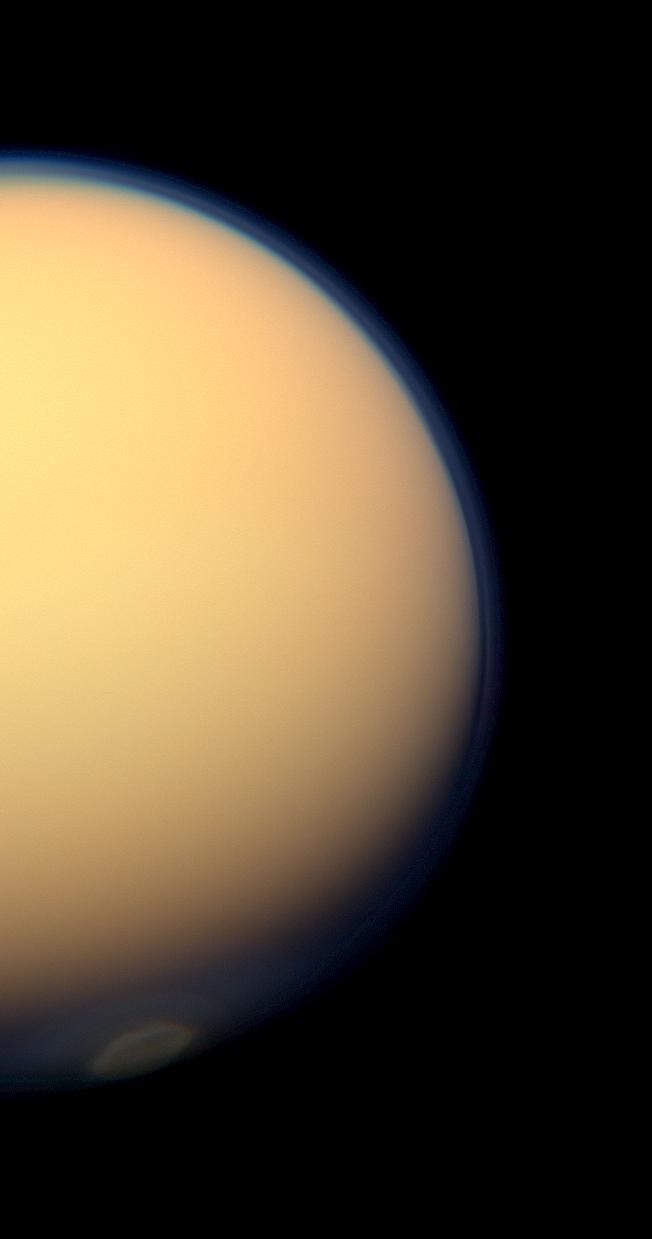
The natural color image above, obtained with the Wide-Angle Camera of the Cassini probe on July 25, 2012 at a distance of about 64,000 miles or 103,000 kilometers from the Orange Moon Titan unveils the yellowish vortex or cyclone developing over the south polar region which is currently experiencing the Autumn season. Image Credit: NASA/JPL-Caltech/SSI.
- To get further information on that news, go to: http://saturn.jpl.nasa.gov/news/newsreleases/newsrelease20121128 and http://www.nature.com/nature/journal/v491/n7426/full/nature11611.html.
November 2, 2012: A Long-Exposure Image of Titan's Disc Reveals that the Atmosphere Releases its Own Light
A long-exposure image of Titan's disc from the imaging camera of the Cassini probe, taken on May 7, 2009, shows a glowing atmosphere without incoming sunlight. At the time of the snapshot, Titan was hidden from the Sun by Saturn so that Titan couldn't receive direct sunlight. The glow generated by the atmosphere of Titan was clearly visible thanks to a 560-second-long exposure time of the camera to get the image.
A processing work was performed on the image of the disc to unveil the extent of the atmospheric glow. A set of two images was presented to show up this surprising atmospheric phenomenon taking shape without sunlight. The left view of the mosaic released by scientists corresponds to a calibrated, but unprocessed image from the imaging camera of the Cassini spacecraft.
The right view of the mosaic was processed to remove reflected light off Saturn. The right view clearly shows the extent of the atmospheric glow. An outer dashed line was incorporated into the view to delimitate the atmospheric area of the glow. The outer limit of the glow appears to be at about 625 miles or 1,000 kilometers in altitude.
The most surprising aspect of the atmospheric glow is that the light is diffusing up from lower down in the haze of the moon, from approximately 190 miles or 300 kilometers above the ground. The stars appearing in the field of view appear as bright streaks due to the change in their relative position to Titan during the long-exposure time of the image.
An astronaut standing in a balloon and evolving in the haze layer of Titan's atmosphere wouldn't notice the glow, simply because it is too faint to detect it. The energy of the glow may represent something like a millionth of a watt. This glow can only be identified in long-exposure time images of a camera.
Robert West, the lead author of a recent study in the journal Geophysical Research Letters and a Cassini imaging team researcher at NASA's Jet Propulsion Laboratory in Pasadena, California pointed out: "It turns out that Titan glows in the dark -though very dimly." He explained: "It's a little like a neon sign, where electrons generated by electrical power bang into neon atoms and cause them to glow. Here we're looking at light emitted when charged particles bang into nitrogen molecules in Titan's atmosphere."
The atmosphere of Titan is mostly composed of molecular nitrogen which represents roughly 94% of its composition. Methane is the second most abundant gas of the atmosphere. It can represent up to 5% of its composition in the Troposphere. There are also significant amounts of argon in the atmosphere.
The haze of Titan's atmosphere is thought to be intimately linked to the action of sunlight. Complex interactions with ultraviolet light from the Sun occur in the upper atmosphere of Titan. The ultraviolet light is likely to break up methane molecules into new compounds such as acetylene (C2H2), ethylene (C2H4), radicals, nitriles or even more complex molecules.
Charged particles and solar energy are at the heart of a complex process of organic interactions in the Titanian atmosphere and on the soil. The atmosphere of the Orange Moon may be even more complex than the atmosphere of the Earth with a complex haze and a cycle involving methane, ethane and propane between the soil and the Troposphere (evaporation and precipitation processes).
Linda Spilker, Cassini project scientist, who is also at JPL advanced: "Scientists want to know what galvanizes the chemical reactions forming the heavy molecules that develop into Titan's thick haze of organic chemicals."..."This kind of work helps us understand what kind of organic chemistry could have existed on an early Earth."
The interaction between the atoms or molecules of the Titanian atmosphere and ultraviolet light from the Sun or electrically charged particles engenders the airglow of the gas layer. Scientists have already identified an airglow from the nitrogen molecules of Titan's atmosphere generated by X-rays and ultraviolet light from our star when the Opaque Moon was illuminated by the Sun.
The observation of May 7, 2009 performed when Titan was hidden from the Sun by Saturn allowed scientists to identify a luminescence phenomenon in the atmosphere that is a very dim light generated by the atmosphere. This glow is only identified with a long-exposure view.
Cassini researchers had expected to identify a glow in the upper atmosphere of the Orange Moon, above 400 miles or 700 kilometers in altitude due to the interactions between the magnetic bubble generated by Saturn and the atmospheric molecules of Titan. Indeed, the magnetic field of the Gas Giant Saturn is likely to drive charged particles and to engender electron exchanges in the atmospheric soup of molecules of Titan.
The observation of a weak glow in the upper atmosphere of Titan was consistent with what scientists had expected. However, scientists were astonished to observe a glow taking shape at a much lower altitude in the atmosphere. The glow appeared to start at an altitude of about 190 miles or 300 kilometers above the surface.
In the absence of sunlight, the glow is likely the outcome of atmospheric interactions between atoms, molecules or charged particles. Let's note however that nearby satellites such as Rhea, Dione or Iapetus can bring sunlight to the Titanian atmosphere via mirror effects similar to the mirror effect of our own moon.
The glow taking shape at a relatively low altitude may not be the outcome of the interactions between charged particles from the Sun and atmospheric particles and it may not be the outcome of the interactions between the magnetic field, charged particles and the atmospheric compounds. In other words, this low-altitude glow doesn't correspond to a magnetic aurora such as that observed on Earth at high latitudes.
Researchers suggest that this particular glow could be caused by deeper-penetrating cosmic rays or by chemical reactions generating light. Robert West pointed out: "This is exciting because we've never seen this at Titan before."..."It tells us that we don't know all there is to know about Titan and makes it even more mysterious."
Scientists have already noticed that the 4 Gas Giants in our Solar System produce their own energy. The amount of energy emitted by the Gas Giants is higher than the amount of energy received from the Sun. Does Titan produce its own energy ?
A glow has also been identified in the atmosphere of Venus in the nightside. The glow is known as the Ashen light and it may be related to lightning but it is only one hypothesis among other hypotheses. Is there lightning in the atmosphere of Titan ? The radio wave instrument of the Cassini probe has detected lightning in the atmosphere of Saturn but it has never identified lightning in the atmosphere of Titan.
Yet, there are clouds, evaporation and precipitation processes on Titan. But the clouds are not made of water or water ice. The clouds of Titan can be composed of methane or ethane and these molecules are not believed to be able to engender an electrical current or lightning.
The radio wave instrument of the Cassini probe will continue to monitor the cloud formations of Titan but the detection of lightning in those clouds would appear really surprising. If there is lightning on Titan, it may most likely occur in the polar regions of the moon where most cloud systems take shape.
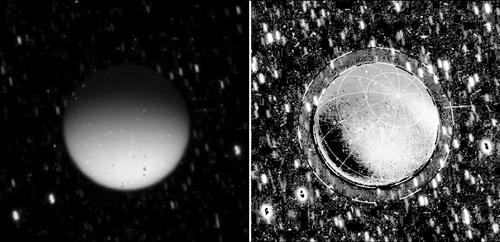
The mosaic above shows a glow in the atmosphere of Saturn's largest moon Titan which was eclipsed by Saturn from the Sun on May 7, 2009. The left image was obtained with a 560-second exposure from the imaging camera of the Cassini probe. The right view, showing the same disc as the disc on the left part of the mosaic, was processed to remove reflected light from the Gas Giant Saturn. It appears that the atmosphere of the Orange Moon generates its own energy since it didn't receive any direct sunlight at that time. Image Credit: NASA/JPL-Caltech/Space Science Institute.
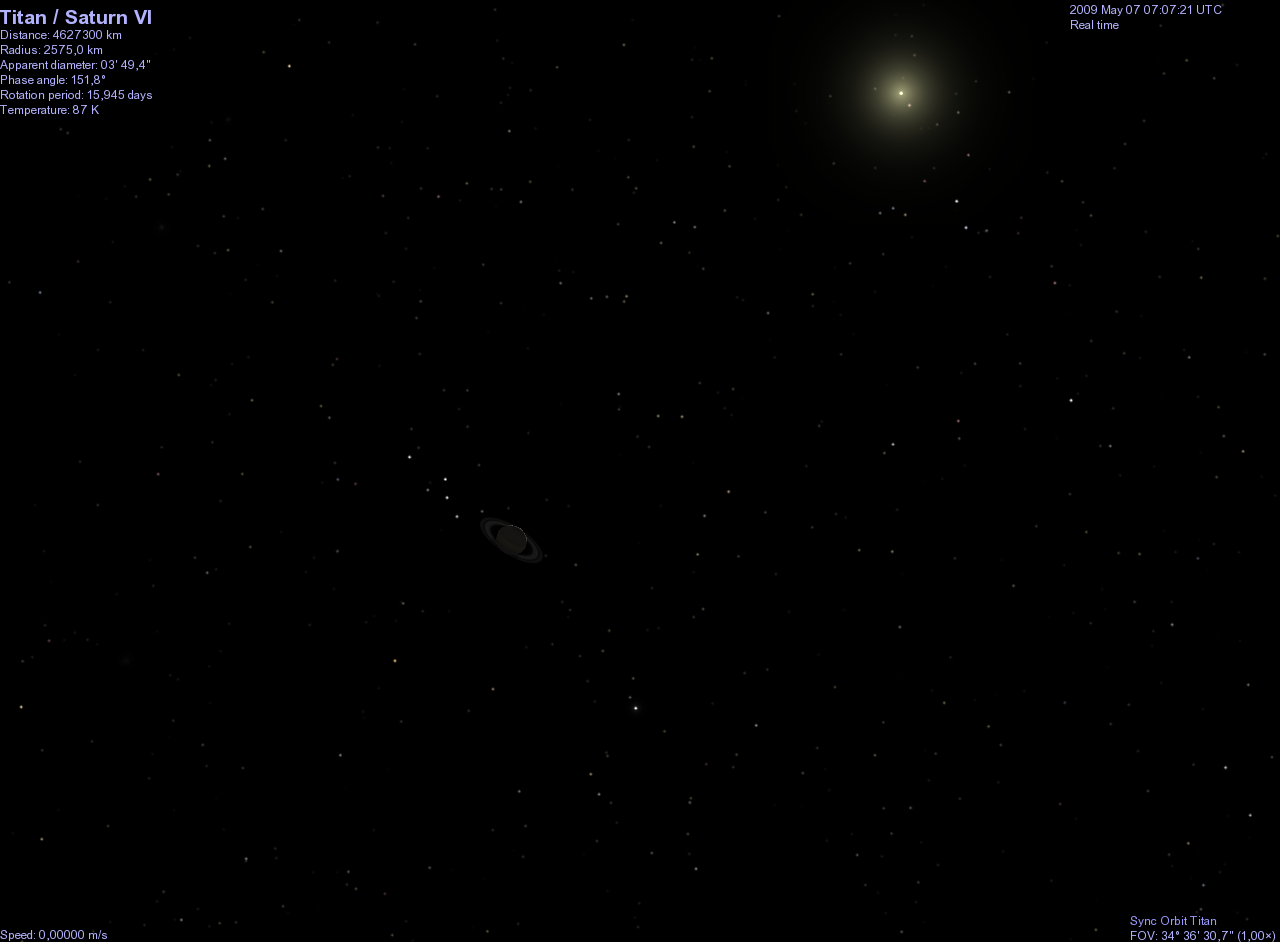
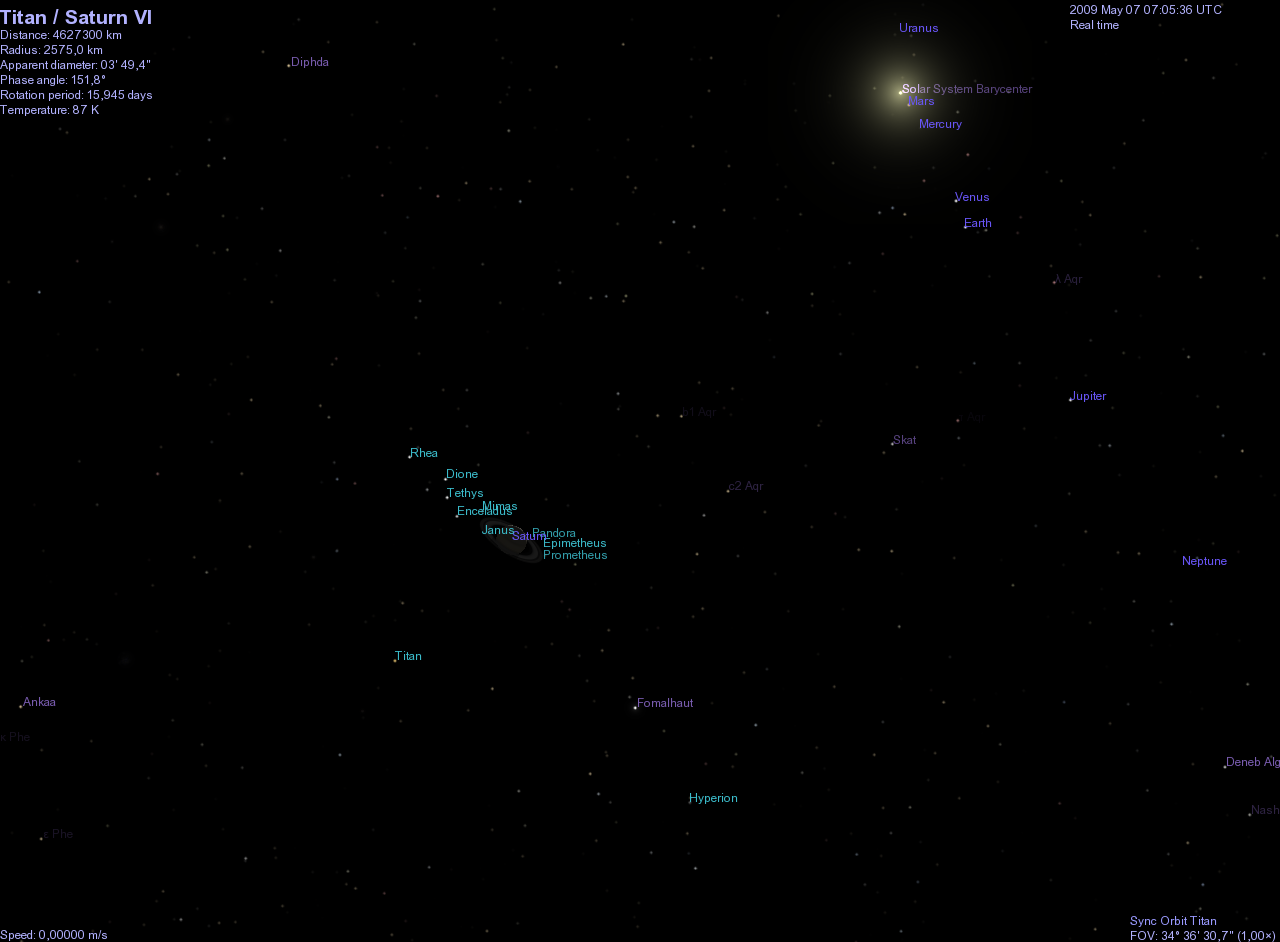
The two images above correspond to simulated images of the relative position of Titan on May 7, 2009, at the time of the long-exposure image showing the luminescence of Titan's atmosphere. One can notice that Saturn eclipses Titan from the Sun so that Titan doesn't receive any direct radiation from the Sun. The lower view shows the same image as the upper view but it also indicates the names of the main stars, planets and moons in the field of view. Image Source: Celestia Simulator. Post Scriptum: The texture of Titan's atmosphere in these images was generated by Marc Lafferre.
- To get further information on that news, go to: http://saturn.jpl.nasa.gov/news/cassinifeatures/feature20121031.
October 19, 2012: A New Radar Analysis Suggests that the South Polar Lake Ontario Lacus May Be the Remnant of an Ancient Sea
New studies based on radar images of Titan's surface reveal the presence of a potential cryovolcano, a relative stability in the level of north polar lakes and a potential ancient sea in the area of the south polar lake Ontario Lacus. The results of the analyses were presented on October 16, 2012 at the American Astronomical Society's Division of Planetary Sciences conference in Reno, Nevada.
A radar image of a topographic feature shaped like a hot cross bun in the northern hemisphere of Titan, taken by the Radar Mapper of the Cassini probe on May 22, 2012 suggests a potential cryovolcanic activity in the area. The bun which is located at about 38.5 degrees north latitude and 203 degrees west longitude resembles a topographic feature located in a volcanic region on Venus.
The circular feature of Titan, which is reminiscent of a giant hot cross bun, is approximately 43 miles or 70 kilometers in diameter with near-perpendicular markings about 37 miles or 60 kilometers wide, intersecting at its center. The similar feature of Venus was identified in a synthetic aperture radar view from NASA's Magellan spacecraft.
This area which appears bright with dark, linear features in the radar image is about 20 miles or 30 kilometers across. The landscape feature, shaped like a dome, is located at the summit of a large volcano called Kunapipi Mons at approximately 33.3 degrees south latitude and 85.5 degrees west longitude. Scientists advance that the network of linear features or cracks on Titan may also be the outcome of fractures generated by uplift from below or by the pressure of a rising magma.
Rosaly Lopes, who is a Cassini radar team scientist based at NASA's Jet Propulsion Laboratory, Pasadena, California pointed out: "The 'hot cross bun' is a type of feature we have not seen before on Titan, showing that Titan keeps surprising us even after eight years of observations from Cassini."..."The 'bun' may be the result of what is known on Earth as a Laccolith, an intrusion formed by magma pushing up from below. The Henry Mountains of Utah are well-known examples of this geologic phenomenon.
A radar analysis of the area of Ontario Lacus has also been performed by a team led by Ellen Stofan who is based at Proxemy Research, Rectortown, Virginia. The group focused his attention on images of the southern hemisphere and the south polar region of the Opaque Moon. Ellen Stofan and her collaborators have identified two good candidates for dry or mostly dry seas and one of the candidates corresponds to the area of the famous south polar lake Ontario Lacus.
Their study is based on Cassini images obtained from 2008 to 2011. A radar view of the area of Ontario Lacus, assembled on the basis of radar images taken from the Cassini probe on July 2009 and January 2010 allowed researchers to determine that the dark and uniform area of Ontario Lacus may be the remnant of an ancient sea whose shoreline can still be discerned today.
Ontario Lacus, which was the first body of liquids identified on Saturn's largest moon is approximately 80 by 235 kilometers across, and likely at least 10 meters or 30 feet deep at its center. The presence of a relatively dark and uniform area around Ontario Lacus allows scientists to advance that the ancient sea was probably as large as 300 by 170 miles across or 475 by 280 kilometers across. The researchers also estimate that the ancient sea was likely less than a few hundred feet or meters deep.
A parallel can be drawn between the partially dried-up sea of the area of Ontario Lacus and the Aral Sea on Earth but the origin of the decrease in the level of the liquid body is undoubtedly different. Some scientists postulate, on the basis of climate models, that seas may have covered large portions of the southern hemisphere less than 50,000 years ago.
Today, a dichotomy in the distribution of lakes, seas and rivers can be observed between the south polar region and the north polar region. It appears that over one hundred lakes and three seas can be identified in the north polar region of the Orange Moon whereas the south polar region is only composed of a few small lakes and Ontario Lacus. How can we explain the hemispheric dichotomy in the concentration of liquid bodies ?
Researchers led by Oded Aharonson, another radar team member based at the California Institute of Technology in Pasadena suggest that cycles similar to Croll-Milankovich cycles on Earth may engender long-term transfer of liquid hydrocarbons such as methane and ethane from pole to pole. Today, the highest concentration of liquids can be found in the north polar region but it may have been the opposite less than 50,000 years ago.
Thus, the dry sea bed observed around Ontario Lacus may have been filled with liquids less than 50,000 years ago due to the evolution of long-term climate cycles. The meteorology is, indeed, closely related to physical and orbital parameters. The Saturn System carries out a revolution around the Sun with an elliptical orbit. The closer Titan is from the Sun, the more heat it receives from the Sun.
Moreover, the seasons of Titan are closely related to the inclination of the rotation axis of the moon to the normal of the orbital plane. The inclination of the rotation axis of Titan is higher than that of the Earth which is likely to strengthen the seasonal differences. A Titan year lasts approximately 29.5 Terrestrial years and each season is about 7 Terrestrial years.
It seems more and more unlikely that radical changes in the distribution of lakes between the poles occur in the course of one Titanian year. The Summer season in the southern hemisphere ended in August 2009 with the start of the Autumn season and since the equinox of August 2009, no significant increase in the level of Ontario Lacus has been observed.
However, one can note that a yellowish vortex is currently developing in the atmosphere of the south polar region. Will it bring rains of ethane or methane ? Will there be significant changes in the area of Ontario Lacus during the next Winter ?
Ellen Stofan advanced: "The seas on Titan are temporary hosts for experiments in prebiotic chemistry, and we know they are cycling from one hemisphere to the other over 100,000 years." She concluded: "I'd love to get a closer look at the seas of the north or these dry seabeds to examine the extent to which this prebiotic chemistry has developed."
The radar swath obtained with the Radar Mapper of the Cassini probe on May 22, 2012 which is centered near 79 degrees north latitude, 58 degrees west longitude and which is approximately 220 by 47 miles or 350 by 75 kilometers in dimension reveals some lakes in the high latitudes of the northern hemisphere. The radar view of the lakes can be compared with radar views of the lakes acquired in September 2006 and October 2006 from the Radar Mapper of the Cassini probe.
The area of the lakes in the northern hemisphere was experiencing the Spring season during the observation of May 2012 and was experiencing the Winter season during the observations of September 2006 and October 2006. The rise of the Sun in the area between the 2006 images and the image of May 2012 doesn't seem to have had any significant influence in the amount of evaporation from the lakes studied here.
The apparent level of the lakes seems to have remained the same since the observations of 2006. That is a bit surprising even if it is in line with climate models that predict a stability in the amount of surface liquids over several years. Thus, the north polar lakes don't appear to be seasonal lakes and they may well be there during the next Summer. This configuration contrasts with the relative instability of liquid bodies in the tropical or equatorial regions.
Dark drainage channels, probably empty, had been identified in the Adiri/Shangri-La Region from the Huygens probe on January 14, 2005 during its atmospheric descent and a temporary darkening in some parts of the low-latitude areas after a rainstorm in 2010 had been observed.
Will we observe net evaporation of liquid methane/ethane in the north polar region in the coming Terrestrial years as the Summer season approaches in the area ? Will we observe net precipitation in the south polar region in the next Terrestrial years as the Winter season approaches in the area ?
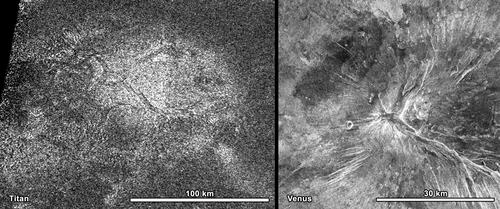
The mosaic above reveals a radar portion of Titan and a radar portion of Venus which reveal a network of dark, linear markings. The radar view in the right part of the mosaic, obtained from the Magellan Spacecraft of NASA, unveils a volcanic feature of Venus located at about 33.3 degrees south latitude and 85.5 degrees west longitude. The volcano observed on Venus is known as Kunapipi Mons. The radar view in the left part of the mosaic, taken from the Radar Mapper of the Cassini probe on May 22, 2012 shows the same kind of topographic feature at about 38.5 degrees north latitude and 203 degrees west longitude. The dark linear features may correspond to fractures engendered by the pressure of rising cryomagma. Image Credit: NASA/JPL-Caltech/ASI.

The radar view above, generated on the basis of radar images obtained from the Radar Mapper of the Cassini probe on July 2009 and January 2010, shows the area of the dark Ontario Lacus. Ontario Lacus, which lies in the high latitudes of the southern hemisphere, was the first lake identified on Titan. One can observe a relatively dark and uniform area around Ontario Lacus implying the presence of a potential ancient sea in the area. Thus, Ontario Lacus may be the remnant of an ancient sea. Is the partial evaporation of the presumed ancient sea related to long-term climate cycles or seasonal factors ? Image Credit: NASA/JPL-Caltech/ASI/Proxemy Research.
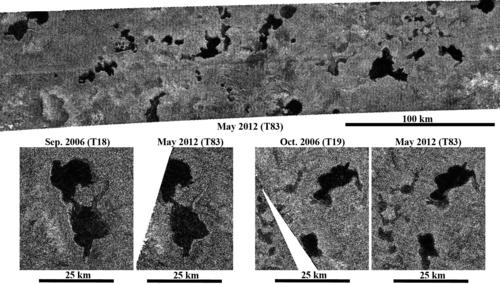
The mosaic of radar images above reveals some north polar lakes of Saturn's largest moon Titan. The radar image in the upper part of the mosaic was taken from the Radar Mapper of the Cassini spacecraft on May 22, 2012. The radar swath from which the image is extracted is centered near 79 degrees north latitude, 58 degrees west longitude and is approximately 220 by 47 miles or 350 by 75 kilometers in dimension. The radar illumination is coming from the bottom of the view. In the lower part of the mosaic, some lakes which had already been imaged by the Radar Mapper of the Cassini probe in 2006 are shown at two different times to reveal the evolution of their level or appearance. The lower left view unveils a lake imaged with the Radar Mapper during the T18 Flyby on September 2006 and the second view from the lower left shows the same lake taken with the Radar Mapper during the T83 Flyby of May 2012. The third view from the lower left reveals other lakes of the region captured during the T19 Flyby of October 2006. The fourth view from the lower left of the mosaic shows the same lakes taken from the Radar Mapper of the Cassini probe during the T83 Flyby of May 2012. No significant changes can be discerned between 2006 and 2012. Yet, the Winter season in the northern hemisphere, supposed to be the dampest period, came to an end in August 2009 marking the beginning of the Spring period in the northern hemisphere. Numerous scientists had expected significant decreases in the level of north polar lakes due to the increase in solar energy reaching the soil of the high latitudes of the northern hemisphere. Image Credit: NASA/JPL-Caltech/ASI.
- To get further information on that news, go to: http://saturn.jpl.nasa.gov/news/cassinifeatures/feature20121016.
October 12, 2012: A New Analysis of the Huygens Probe Landing Suggests a Relatively Soft Surface, More Complex Than Previously Thought
The Cassini-Huygens spacecraft, launched from the Blue Planet in 1997 entered the Saturn System in mid-2004. The Huygens probe, of the European Space Agency, was released by the Cassini orbiter and landed on Titan on January 14, 2005. The touchdown occured in the equatorial and tropical region in the area of the bright Adiri and the dark Shangri-La.
The Huygens spacecraft incorporated multiple instruments or sensors. One can mention the penetrometer and the Descent Imager/Spectral Radiometer and the Gas Chromatograph Mass Spectrometer supplied by NASA.
Scientists were able to reconstruct the interaction between the probe and the soil during the landing phase by analyzing data from multiple instruments, particularly changes in the acceleration. Scientists also took into account computer simulations as well as a drop test mobilizing a model of the Huygens probe designed to reproduce the landing.
It appears that the Huygens probe bounced, slid and wobbled its way to stabilize in the 10 seconds after landing. At first glance, this scenario of the impact is not consistent with the scenario of a landing on mud since the absorption rate of the soil is relatively limited. So, what is the hardness or the softness level of the soil ?
The study unveils that the Huygens module made a dent 4.7 inches or 12 centimeters deep during the first contact with the surface. The probe, whose mass is approximately 400 pounds or 200 kilograms, impacted the surface with an impact speed that was similar to dropping a ball on our planet from a height of approximately 3 feet or one meter.
The spacecraft tilted by about 10 degrees in the direction of movement, then slid 12 to 16 inches or 30 to 40 centimeters across the ground. The surface friction slowed the probe which wobbled back and forth five times until it stabilized. Scientists suggest that each wobble was approximately half as large as the previous one. The sensors of the craft went on detecting small vibrations for another two seconds, until the movement subsided almost 10 seconds after landing.
The results of the analysis are presented in a paper appearing in the journal Planetary and Space Science. The lead author of the paper, Stefan Schröder of the Max Planck Institute for Solar System Research in Kaltenburg-Lindau, Germany advanced: "A spike in the acceleration data suggests that during the first wobble, the probe likely encountered a pebble protruding by around an inch [2 centimeters] from the surface of Titan, and may have even pushed it into the ground, suggesting that the surface had a consistency of soft, damp sand."
The famous color image of the ground from the Huygens probe after landing reveals a field of eroded stones or pebbles around the probe suggesting that the Huygens probe landed into a dried-up river. At first sight, the soil seems to be mostly composed of a wet or humid sand. In the field of view, a pebble seems to have been fractured or broken due to the impact of the probe.
In fact, the results of the analysis suggest that the soil is relatively soft. The surface appears more complex than previously thought, however. The analyses demonstrate that the surface was hard if the object or the module put little pressure on the ground. On the other hand, the surface is likely to subside, collapse or significantly sink if an object put more pressure on the soil. A relatively thin layer of hard material or frozen material may cover a relatively soft layer implying collapsing effects if the probe penetrating the ground is relatively heavy.
Erich Karkoschka, a co-author at the University of Arizona, Tucson pointed out: "It is like snow that has been frozen on top."..."If you walk carefully, you can walk as on a solid surface, but if you step on the snow a little too hard, you break in very deeply."
If the probe had landed into a wet, mud-like soil, the instruments of the probe would have recorded a full or quasi-full absorption of the probe by the soil with a limited amount of bouncing or sliding or without any bounce or slide. The depression generated by the probe implies a relatively soft surface and the bounces or the slide observed imply that the soil is not extremely soft.
Stefan Schröder advanced: "We also see in the Huygens landing data evidence of a 'fluffy' dust-like material -most likely organic aerosols that are known to drizzle out of the Titan atmosphere- being thrown up into the atmosphere and suspended there for around four seconds after the impact."
The upward release of dust from the ground during the impact of the Huygens probe demonstrates that the soil is most likely dry even if the image of the ground taken from the Huygens probe seems to unveil a relatively wet surface.
As a result, if the soil is dry in the Adiri/Shangri-La region, one can suggest that there had not been any rain of liquid ethane or methane for some time before the touchdown.
Nicolas Altobelli, ESA's Cassini-Huygens project scientist concluded: "This study takes us back to the historical moment of Huygens touching down on the most remote alien world ever visited by a landing probe."..."Huygens data, even years after mission completion, are providing us with a new dynamical 'feeling' for these crucial first seconds of landing."
The aerial views of the area taken with the Descent Imager/Spectral Radiometer (DISR) of the Huygens probe had revealed bright hills sculpted with fractures or drainage channels. The bright area represented by the hills contrasted with the dark areas of Shangri-La. The drainage channels seemed to be dried up and the dark, reddish area also seemed to be dry. Does the reddish area correspond to a former sea or lake ? Is the moisture level related to seasonal factors in the area ?
Radar data have shown that the lakes, seas or rivers are mostly concentrated in the polar regions. The observations were mostly performed during the Winter season in the northern hemisphere and the Summer season in the southern hemisphere. Liquid methane or liquid ethane seem to take shape in the coldest places of the moon, where the molecules can condense, form clouds and fall in the form of rain. Scientists tend to believe that the amount of liquid in the polar regions is at its highest level during the Winter period.
Some scientists have recently shown that the changing seasons of the Opaque Moon affect it more than previously thought. Doctor Athena Coustenis from the Paris-Meudon Observatory in France put forward this idea and presented her results at the European Planetary Science Congress in Madrid on Friday 28th September.
Doctor Athena Coustenis argued: "As with Earth, conditions on Titan change with its seasons. We can see differences in atmospheric temperatures, chemical composition and circulation patterns, especially at the poles. For example, hydrocarbon lakes form around the north polar region during winter due to colder temperatures and condensation. Also, a haze layer surrounding Titan at the northern pole is significantly reduced during the equinox because of the atmospheric circulation patterns. This is all very surprising because we didn't expect to find any such rapid changes, especially in the deeper layers of the atmosphere."
The seasonal cycles are closely related to the inclination of the rotation axis of the moon to the normal of its orbital plane. The tilt of the rotation axis of Titan is a little higher than that of the Earth. The seasonal cycles also depend on the amount of solar energy reaching the atmosphere and the ground. The amount of solar energy reaching the Orange Moon intimately depends on the distance of the Opaque Moon to the Sun and this distance varies over time because the orbit of Titan around the Sun is elliptical.
Today, the polar regions of Titan seem to be particularly wet with seas, lakes and rivers and the equatorial and tropical regions seem to be particularly dry with dark areas dominated by Seif dunes or linear and parallel dunes extending over long distances and shaped by prevailing winds. So, how can we explain the dark and dry channels in the bright hills observed by the Huygens probe during its atmospheric descent on January 14, 2005 ? If there is a precipitation period in this area, it may well be the Autumn period or the Spring period when massive cloud formations can take shape at low latitudes. Let's be patient and let's observe.
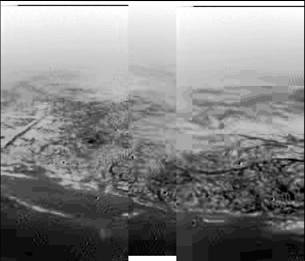
The composite image above corresponds to an aerial view of the Adiri/Shangri-La region obtained from the Huygens spacecraft during its atmospheric descent on January 14, 2005. One can clearly observe some bright hills composed of fractures or dark drainage channels and a darker lower area. The portions of the composite view were acquired from an altitude of approximately 8 kilometers. Image Credit: ESA/NASA/JPL/University of Arizona.
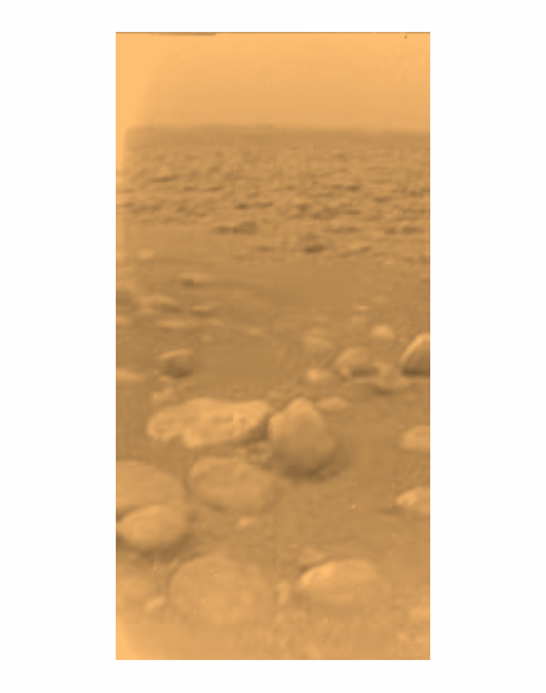
The color view above, unveiling the soil of the Orange Moon, was taken from the Huygens probe on January 14, 2005 after the touchdown. One can clearly see eroded stones or pebbles. The soil may be composed of a mixture of water ice and hydrocarbon ice. The erosion level of the stones suggests that the spacecraft may have landed into a dried-up river. Image Credit: ESA/NASA/JPL/University of Arizona.
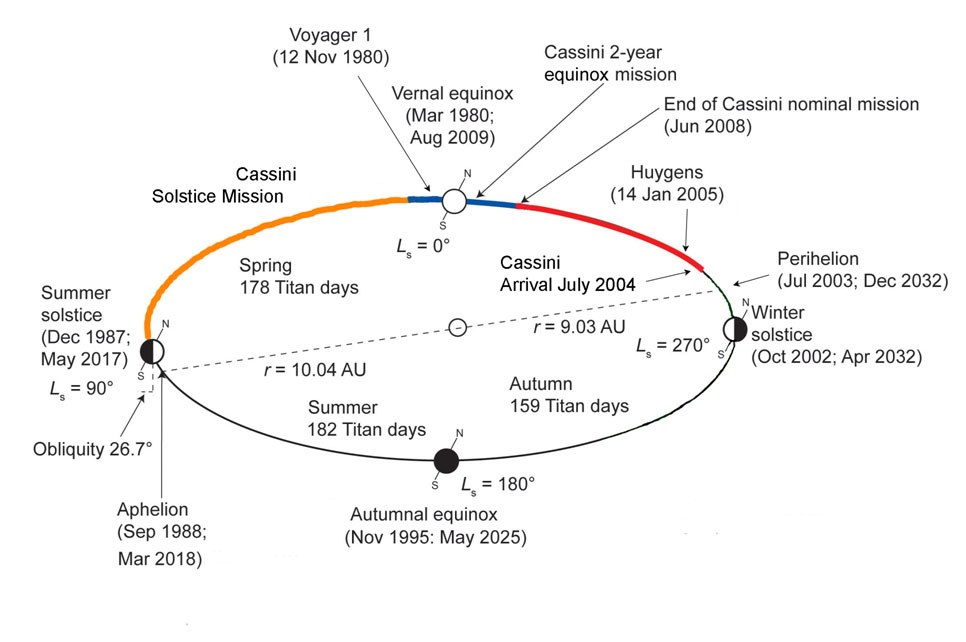
The diagram above reveals, in particular, some seasonal parameters in the evolution of Saturn's largest moon over time. One can note that the distance of Titan to the Sun varies over time due to its elliptical orbit. The seasonal changes are made possible by the relatively high inclination of the rotation axis of the Orange Moon relative to the normal of its orbital plane to the Sun. One can observe for instance that the latest Vernal equinox occured in August 2009, marking the end of the Winter season and the beginning of the Spring season in the northern hemisphere. The level of the lakes and seas in the high latitudes of the northern hemisphere may be higher in the Winter period than in the Summer period due to condensation phenomena and higher precipitation. Image Credit: Ralph Lorenz.
- To get further information on that news, go to: http://saturn.jpl.nasa.gov/news/cassinifeatures/feature20121011 and http://www.europlanet-eu.org/demo/index.php?option=com_content&task=view&id=395&Itemid=41.
September 14, 2012: Titan's Exaggerated Flattening may be Related to Meteorological Phenomena and the Hydrocarbon Cycle
The shape of planetary bodies tends to be a little bit squashed at the poles due to the rotation speed of the globe. As a result, planets, moons and even stars are not perfect spheres. Surprisingly, the flattening of the globe of Saturn's largest moon, Titan, at the poles is relatively high or higher than what it should be on the basis of the known rotation speed.
The equatorial diameter of the Opaque Moon is approximately 5,150 km or 3,200 miles. The theory suggests that the equatorial diameter is 1,345 feet or 410 meters longer than the diameter from the south pole to the north pole. In reality, the difference between the equatorial diameter and the pole-to-pole diameter is higher than the theoretical difference. The equatorial diameter appears to be 2,231 feet or 680 meters larger than the pole-to-pole diameter. Therefore, there is an additional 886 feet or 270 meters of flattening relative to the theoretical flattening. How can we explain this exaggerated flattening ?
Several hypotheses can be envisaged to account for this exaggerated flattening of Titan. A study from 2009 had suggested that the current shape of the moon is closely related to a faster spin of the moon in the past. Depending on its internal structure, the Orange Moon would have needed to rotate from 15 to 30 percent faster in the past. The shape of the moon may also be related to variations in the thickness of the icy shell, depending on the latitude as some researchers had proposed in 2010.
A new theory proposed by Mathieu Choukroun and Christophe Sotin of NASA's Jet Propulsion Laboratory, Pasadena, California advances the hypothesis that meteorological phenomena may have engendered a change in the shape of the moon with an exaggerated flattening of the polar areas. In the deep, thick and opaque atmosphere of the Orange Moon, there is an hydrological cycle involving methane and ethane.
Methane can represent up to 5% of the composition of the Titanian troposphere whereas ethane is much less abundant. There is a methane/ethane cycle involving evaporation and precipitation processes. The seas, lakes and rivers have been identified by the Radar Mapper of the Cassini spacecraft in the polar regions of Titan. The lakes are apparently mostly composed of ethane molecules in the polar regions. A giant ethane cloud system engulfing the north polar region had been identified a few years ago with the VIMS of the Cassini probe.
Mathieu Choukroun and Christophe Sotin envisage a porous crust in the polar regions. Liquid ethane resulting from rainfall, rivers or liquid bodies may seep into the polar crust and displace the liquid methane present in the underground of the area. The methane of the so-called clathrates may be swapped out for ethane. This meteorological process with the ethane-for-methane swap may engender an increase in the density of the crust. Due to the rise in the density, the crust of the polar regions may subside resulting in a flattened polar area compared to the equatorial regions which are expected to contain far less ethane than at the poles.
Prevailing global circulation models predict ethane rain on the poles of the Orange Moon during the winters. The observations from the Cassini spacecraft which entered the Saturn System in mid-2004 are in line with the predictions of the models regarding the concentration of liquid hydrocarbons which are mostly found in the polar areas. The observations have revealed a giant ethane cloud system over the region of Kraken Mare, Ligeia Mare and Punga Mare as well as a dark polar hood or dark haze over the north polar area.
Likewise, the infrared or near-infrared data as well as the radar data have revealed the presence of a giant lake in the south polar region known as Ontario Lacus. Ontario Lacus was first identified during the Summer season in the southern hemisphere and cloud systems have been clearly observed during that season in the southern hemisphere.
The lakes, seas and rivers of the north polar area have been identified during the Winter period. The Winter period in the northern hemisphere and the Summer period in the southern hemisphere ended in August 2009 marking the start of the Spring season in the northern hemisphere and the start of the Autumn season in the southern hemisphere. Scientists expect a decrease in the amount of liquid ethane or methane in the north polar region as the Summer season appraches because there may be more and more evaporation and less and less precipitation.
By contrast, the south polar region may receive more and more rain as the Winter season approaches. The level of Ontario Lacus may significantly increase. The dark Mezzoramia may become the equivalent of Kraken Mare in the southern hemisphere if monsoon events occur as some researchers suggest. A recent natural-color image of the south polar region reveals a fast-spinning yellow vortex which may continue to develop. This yellow vortex is reminiscent of the giant ethane vortex which had been observed a few years ago over the north polar region. Will this yellow vortex engender ethane or methane rain ?
Surprisingly, the dark equatorial areas appear relatively dry compared to the polar regions. The dark Shangri-La region or the dark Fensal/ Aztlan turn out to be dominated by Seif dunes or parallel and linear dunes extending over long distances. Yet, the Huygens probe which plunged into the Shangri-La/ Adiri region on January 14, 2005 transmitted aerial photos of the bright hills of Adiri sculpted by dark drainage channels or fractures. The Huygens probe landed into what appears to be a riverbed or a dried-up river since the image from the ground unveils a field of eroded stones or pebbles.
Global circulation models had predicted far more ethane rain from the deep and thick atmosphere of the Opaque Moon. Is the missing ethane hidden beneath the crust which is thought to be relatively porous ?
Both scientists performed laboratory experiments to simulate the exotic environment of Titan but the temperatures generated were far warmer than what's encountered on Titan and the experiments don't reproduce the same level of density for the clathrate formations. Nevertheless, the experiments suggest that the relatively porous underground is likely to allow the ethane-for-methane swap. Since ethane is more massive than methane, the subsurface invasion of ethane will mechanically increase the density of the crust.
With a higher density, the crust is likely to subside or collapse resulting in more flattened polar areas compared to equatorial or tropical regions which appear to be mostly dry. Scientists calculated that the ethane-for-methane substitution will have a flattening effect if the ethane invasion penetrates up to about 9,500 feet or 2,900 meters, plus or minus 4,300 feet or 1,300 meters beneath the surface. This process would work best in a configuration where rainfall is concentrated in the polar areas.
Researchers were able to determine the time it took for this ethane-for-methane swap to engender the flattening of the moon. The time is closely related to the formation rate of ethane in the atmosphere. If this rate has been constant over time, one can postulate that it took 300 million to 1.2 billion years for the atmosphere to produce enough ethane to make the poles subside or sink. The relatively small amount of craters is consistent with the hypothesis of frequent rainfall of ethane or methane and the persistence of atmospheric methane over time suggests an internal source. Cryovolcanoes regularly spewing methane into the atmosphere may exist on Titan.
A parallel can be drawn between the flattening of Titan and the flattening of the Dwarf Planet Ceres which is believed to hide a subsurface ocean probably accounting for its observed flattening. The rotation speed and the internal structure of a planetary body remain key elements to account for the level of flattening of the planet or moon. Meteorological cycles involving methane or ethane can change regionally the geological structure of the crust leading to subsidence phenomena.
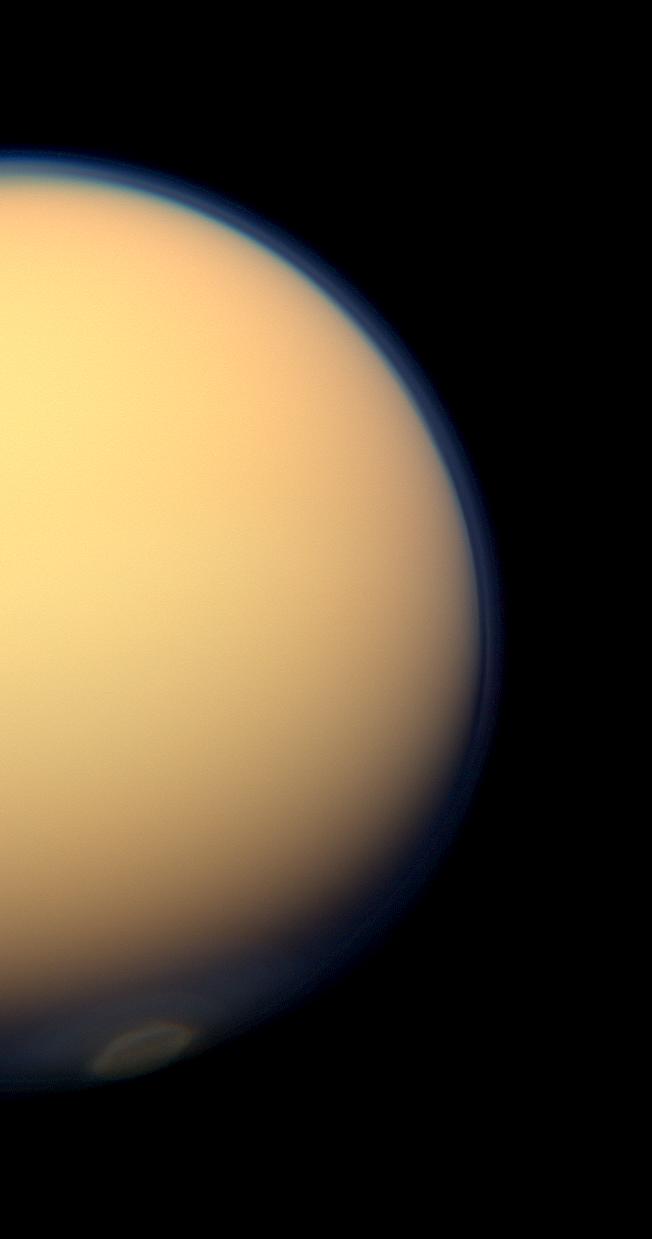
The natural color image of Titan above, obtained with the ISS Wide-Angle Camera of the Cassini spacecraft on July 25, 2012 at a distance of about 64,000 miles or 103,000 kilometers from the Orange Moon and combining views taken using red, green and blue spectral filters reveals the opaque, deep and thick atmosphere of Saturn's largest moon. One can notice the blue outer layers of the atmosphere as well as a yellow south polar vortex. This rapidly rotating vortex is reminiscent of the giant ethane cloud system engulfing the north polar region observed a few years ago during the Winter period. Some researchers predict that this mass of swirling gas will continue to develop as the Winter season approaches in the southern hemisphere. This vortex may bring a large amount of rainfall of ethane or methane in the south polar region. New pools of liquids may take shape in the south polar region and Ontario Lacus may see its level rise in the coming years. The soil may absorb a large amount of liquid hydrocarbons and this process may have subsidence or collapsing effects as some scientists suggest.
- To get further information on that news, go to: http://saturn.jpl.nasa.gov/news/cassiniscienceleague/science20120913.
July 21, 2012: Weak Erosional Processes Generated by Titan's Rivers ?
Titan is the only moon in the Solar System covered by a significant atmosphere. The opaque atmosphere of the Orange Moon Titan is reminiscent of the Terrestrial atmosphere because the atmospheres of Titan and the Earth are mostly composed of molecular nitrogen.
However, the troposphere of Titan has the particularity of harbouring a large concentration of methane. Like in the atmosphere of the Earth, cloud systems can form in the atmosphere of Titan. Unlike the Terrestrial clouds, the Titanian clouds can be composed of methane or ethane. Evaporation and precipitation processes take shape on Titan.
The radar data and the near-infrared data obtained from the Cassini spacecraft since 2004 reveal that the pools of liquids and the clouds are mostly concentrated in the high latitudes of Saturn's largest moon.
This dichotomy between the equatorial or tropical region and the polar regions may be closely related to seasonal factors. A Titanian year lasts approximately 29.5 Terrestrial years and a season lasts approximately 7 Terrestrial years.
The Winter season in the northern hemisphere and the Summer season in the southern hemisphere ended in August 2009. The northern hemisphere is now in the Spring season whereas the southern hemisphere is in the Autumn season.
The images from the Huygens probe acquired during its atmospheric descent into the Adiri/Shangri-La region on January 14, 2005 have revealed bright hills sculpted by fractures or drainage channels and a reddish terrain. The ground may be mostly composed of water ice.
A new study led by researchers at MIT and the University of Tennessee at Knoxville reveals, on the basis of river network analyses, that rivers have generated surprisingly little erosion in some regions of Saturn's largest moon.
Two hypotheses are envisaged to account for this apparent paradox. First, the weak erosional processes may be due to the nature of the material on the ground which resists the action of liquid methane or liquid ethane. The second hypothesis suggests the existence of geysers or cryovolcanoes which have a resurfacing effect or which may have wiped out older riverbeds and landforms.
Taylor Perron, the Cecil and Ida Green Assistant Professor of Geology at MIT pointed out: "It's a surface that should have eroded much more than what we're seeing, if the river networks have been active for a long time."..."It raises some very interesting questions about what has been happening on Titan in the last billion years." A paper presenting the findings of the researchers will appear in the Journal of Geophysical Research-Planets.
The VIMS data and the radar data have shown that the surface of the Orange Moon is relatively young. Very few impact craters have been identified on Titan. The low amount of craters suggests that the surface is between 100 million and one billion years old. However, this may be related to erosion or resurfacing and the moon may be in fact approximately four billion years old, roughly the age of the Solar System. The winds, the rain, the geysers and the cryovolcanic eruptions are likely to create significant erosional processes which make craters disappear.
Taylor Perron advanced: "We don't have many impact craters on Earth."..."People flock to them because they're so few, and one explanation is that Earth's continents are always eroding or being covered with sediment. That may be the case on Titan, too."
The action of advancing glaciers, cryovolcanic eruptions, rivers and plate tectonics is likely to reshape the landscape and to erase some impact craters on Titan like on our planet. A layer of sediments is likely to form on the ancient layer.
Very little is known about the properties of the liquids forming the seas, lakes or rivers on Titan. Are they viscous, are they as mobile as the liquid water forming the rivers on Earth ? How volatile are they ? The interaction between the soil and the rivers can only be studied from the radar and VIMS data acquired from the Cassini spacecraft.
Taylor Perron argued: "It's an interesting challenge."..."It's almost like we were thrown back a few centuries, before there were many topographic maps, and we only had maps showing where the rivers are."
Taylor Perron performed an image analysis with MIT graduate student Benjamin Black. They tried to determine the extent to which river networks may have renewed the surface of the Orange Moon. Taylor Perron and Benjamin Black worked on 52 prominent river networks from four regions on Saturn's largest moon.
They compared the views with a model of river network evolution developed by Taylor Perron. This model takes several variables into account. For instance, the strength of the underlying material and the rate of flow through the river channels are key parameters in the model.
The slow erosion of a river through the ice will tend to engender a treelike network of tributaries instead of a linear channel. The power of the flow will have a significant influence on the shape of the river.
Benjamin Black noticed, thanks to the model, that the rivers of Titan resembled the early stages of a typical river's evolution on the "Blue Planet". It appears that some rivers have generated very little erosion in some areas. As a result, the power of the liquid to sculpt the landscape appears relatively weak on Titan.
Regarding the rivers, Benjamin Black explained: "They're more on the long and spindly side."..."You do see some full and branching networks, and that's tantalizing, because if we get more data, it will be interesting to know whether there really are regional diffrences."
Benjamin Black performed a comparative analysis on the basis of the river observations on Titan, of the volcanic terrain on the island of Kawai and of recently glaciated landscapes in North America. Those places reveal river networks which have a similar shape to the river networks found on the Orange Moon. One can infer that geologic processes may have recently reshaped the icy landscape of Titan.
The topographic or geologic analysis of the river areas allows scientists to better understand how the rivers develop or take shape. Oded Aharonson, a professor of planetary science at the California Institute of Technology pointed out: "Besides Earth, Titan is the only world where we see active river networks forming as a result of an active hydrologic cycle."..."The finding suggests the process of river erosion on Titan is currently responding to resurfacing or resetting of the surface."
Taylor Perron concluded: "It's a weirdly Earth-like place, even with this exotic combination of materials and temperatures."..."And so you can still say something definitive about the erosion. It's the same physics."
The winds are known to sculpt the landscape in the low latitudes of the moon, engendering Seif dunes or linear and parallel dunes extending over long distances. In the high latitudes of Titan, the dunes seem absent due to the humidity level or the dampness level and a wet terrain filled with seas, lakes and rivers. Do the liquids infiltrate into the soil ? To what extent do they erode the landscape ?
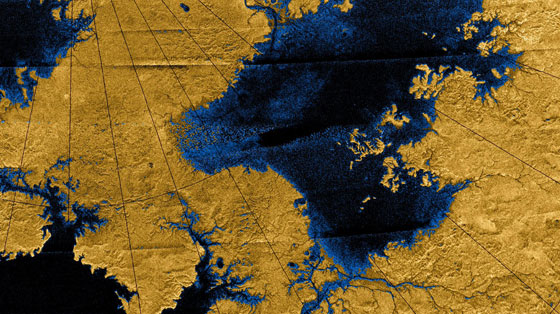
The false-color image above corresponds to a radar portion of the north polar pools of liquids. The original radar image was obtained with the Radar Mapper of the Cassini probe. One can clearly observe the lakes, the coastline as well as networks of drainage channels. The lakes are likely composed of a mixture of ethane and methane. The harsh environment of Titan allows methane, ethane and propane to appear in their liquid form on the surface since the environmental temperature is approximately -180 degrees Celsius, -292 degrees Fahrenheit or 93 Kelvin. Image Source: NASA/JPL/USGS.
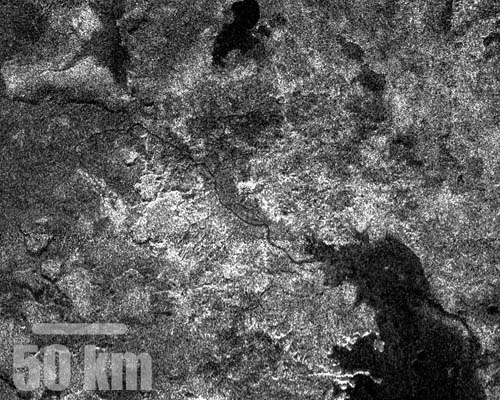
The radar view above corresponds to a radar portion of a radar swath acquired with the Radar Mapper of the Cassini probe during the Titanian flyby of February 22, 2007. One can notice a long drainage channel connected to a large pool of liquids. The scale was incorporated by Marc Lafferre into the original radar image. Original Radar Image Credit: NASA/JPL-Caltech.
- To get further information on that news, go to: http://web.mit.edu/newsoffice/2012/river-networks-on-titan-0720.html.
July 11, 2012: Seasonal Changes Revealed by a New Vortex in Titan's South Polar Region
Saturn's largest moon Titan is the only moon in the Solar System covered with a significant atmosphere. The Huygens probe which landed in the Shangri-La/Adiri area on January 14, 2005 recorded an atmospheric pressure of 1467 hPa on the ground which is higher than on Earth at sea level. The Titanian atmosphere is mainly composed of nitrogen. There are large amounts of methane in the troposphere. Methane can reach up to 5% of the atmospheric composition.
A year on Titan corresponds to approximately 29.5 Terrestrial years and a Titanian season lasts about 7 Terrestrial years. Titan's climate and meteorology appear particularly complex. Dynamic cloud systems have been observed in the south polar region in the area of Ontario Lacus during the Summer period in the southern hemisphere. A giant ethane cloud system has also been clearly identified above the north polar region during the Winter period in the northern hemisphere. Transient cirrus-like clouds have been observed at mid-latitudes.
Since the arrival of the Cassini/Huygens spacecraft in the Saturn System in 2004, researchers have had the opportunity to determine seasonal changes on the Orange Moon. The distribution of the clouds and the haze seems to be intimately linked to seasonal factors. During the Winter period in the northern hemisphere, a giant ethane cloud system or a vortex with a mass of swirling gas had been seen from the VIMS instrument of the Cassini probe (late 2006).
The Winter season in the northern hemisphere ended in August 2009 with the equinox which marked the start of the Spring season in the northern hemisphere and the start of the Autumn season in the southern hemisphere. Scientists had anticipated that the north polar hood and the giant ethane cloud of the north polar region would progressively disappear with the increasing amount of solar energy reaching the north polar region. In parallel, the south polar region was expected to attract more and more haze and clouds as the Winter season in the southern hemisphere is approaching.
The meteorological hypothesis predicting a migration of the haze and the clouds from the north polar region to the south polar region appears correct on the basis of a recent image acquired from the Cassini probe. A natural color image of Titan's south polar region obtained before the distant flyby of June 27, 2012 shows a vortex or a swirling mass of gas reminiscent of the Terrestrial vortex observed over the ocean or reminiscent of the giant ethane cloud system which had been observed in the north polar region a few years ago.
This vortex may get bigger as the Winter season in the southern hemisphere approaches because the area may receive less and less energy becoming colder, stimulating condensation phenomena in the upper atmosphere. The vortex appears to be a concentration of high-altitude haze.
Tony Del Genio, a Cassini team member at NASA's Goddard Institute for Space Studies, N.Y. pointed out: "The structure inside the vortex is reminiscent of the open cellular convection that is often seen over Earth's oceans."..."But unlike on Earth, where such layers are just above the surface, this one is at very high altitude, maybe a response of Titan's stratosphere to seasonal cooling as southern winter approaches. But so soon in the game, we're not sure."
Will the north polar hood or north polar vortex disappear as the Summer season in the northern hemisphere approaches ? The increasing amount of solar energy in the northern hemisphere may favour the disintegration of the haze and the cloud systems. The atmospheric circulation of the haze may go from the illuminated north polar region to the cooling south polar region which will receive less and less light and less and less solar energy. This process seems to be causing downwellings over the south polar region and the formation of a vortex and a high-altitude haze.
The first signs of haze formation in the south polar region were identified on the basis of images acquired with the visible light cameras in March and on the basis of infrared images taken with the Visual and Infrared Mapping Spectrometer (VIMS) on May 22 and June 7, 2012. Red, green and blue colors were assigned to wavelengths mostly sensitive to the stratosphere, the troposphere and surface features in order to reveal the development of a hood of high-altitude haze which appears orange in the composite view of Titan's south polar region.
The haze evolves several hundred miles or kilometers above the ground. The new south polar vortex may illustrate the process of open cell convection, a process where air sinks in the center of the cell and goes up at the edge forming clouds at all edges.
Christophe Sotin, a VIMS team member at NASA's Jet Propulsion Laboratory, Pasadena, California advanced: "VIMS has seen a concentration of aerosols forming about 200 miles [300 kilometers] above the surface of Titan's south pole."..."We've never seen aerosols here at this level before, so we know this is something new."
The upper atmosphere of Titan appears particularly complex with a series of detached haze layers and a complex chemistry or haze influenced by the action of ultraviolet light which tends to break up methane molecules into other organic molecules. The interaction between UV light and atmospheric methane can lead to the formation of radicals, acetylene (C2H2) or ethylene (C2H4), for instance.
Bob West, deputy imaging team lead at JPL argued: "Future observations of this feature will provide good tests of dynamical models of the Titan circulation, chemistry, cloud and aerosol processes in the upper atmosphere."
Will the vortex engender rainfall of methane or ethane and will there be new pools of liquids and new rivers in the south polar region when the south polar region experiences the Winter season ? The researchers had hypothesized that the dichotomy in the amount of liquid bodies between the south polar region and the north polar region was mostly related to orbital factors. We'll may know soon whether this hypothesis is correct.
A dark area like Mezzoramia located in the high latitudes of the southern hemisphere may progressively fill with the increasing storms and rainfall of methane or ethane. The south polar region may also host soon its own "Kraken Mare".
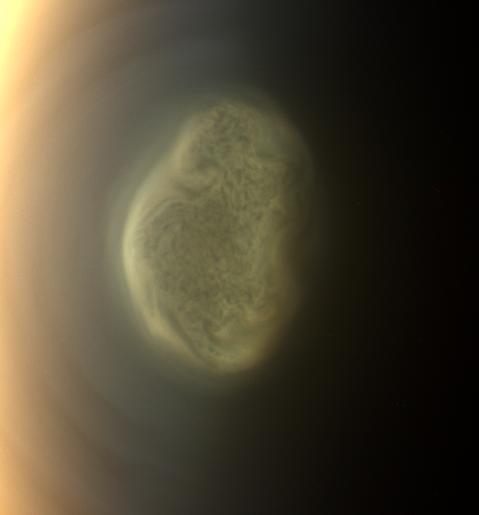
The natural color view above obtained from the Narrow-Angle Camera of the Cassini spacacraft late on June 26, 2012 at a distance of approximately 301,000 miles or 484,000 kilometers from Titan reveals a yellow vortex forming over the south polar region currently experiencing the Autumn season. Will it continue to grow as the Winter season is approaching in the area ? Will it be accompanied by rainfall of ethane or methane fueling existing lakes or new lakes? Image Credit: NASA/JPL-Caltech/Space Science Institute.
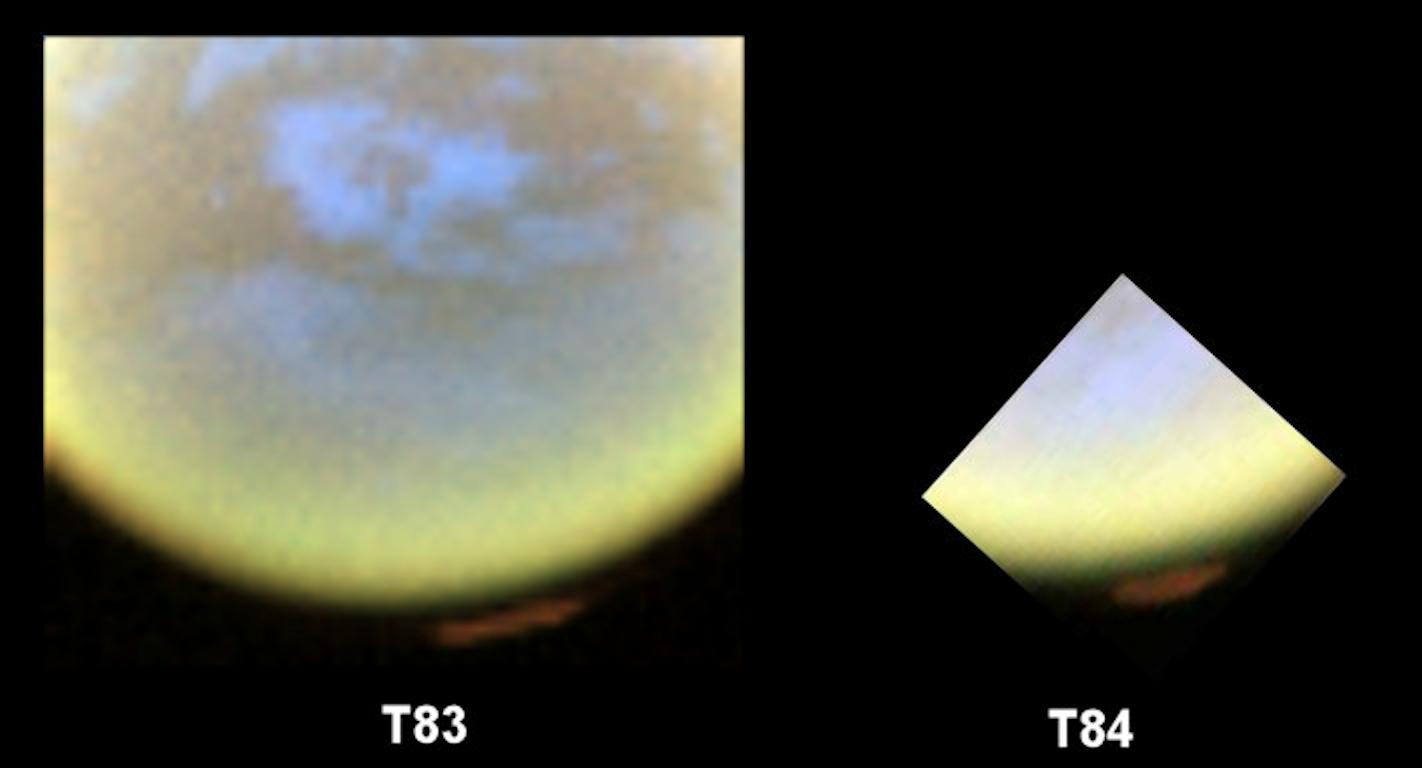
The set of images above shows two infrared images taken with the Visual and Infrared Mapping Spectrometer of the Cassini spacecraft on May 22 and June 7, 2012. The views are made of false colors and they reveal the development of a hood of high-altitude haze over the south polar region of the Opaque Moon. The haze identified by scientists appears orange in this mosaic. Will we see a giant ethane cloud engulfing the south polar region in the coming years as the Winter period is approaching. If there is a meteorological symmetry between the north polar region and the south polar region of Titan, one might expect the same kind of ethane cloud over the south polar in the coming years as the one observed in the north polar region in late 2006. Image Credit: NASA/JPL-Caltech/University of Arizona/LPGNantes.
- To get further information on that news, go to: http://saturn.jpl.nasa.gov/news/newsreleases/newsrelease20120710.
June 30, 2012: A Potential Subsurface Ocean on Titan Inferred from Cassini Data Showing Temporal Distortions of the Moon's Shape
Saturn's largest moon Titan is among the celestial bodies suspected to harbour a subsurface ocean of liquid water. The Cassini observations of the icy moon Enceladus reveal geysers made of water emanating from the icy fractures or "Tiger Stripes" in the south polar region of Enceladus. Does this cryovolcanic activity represent the sign of the presence of an internal ocean ?
Can we advance the hypothesis that the Orange Moon Titan also experiences cryovolcanic eruptions ? Are there signs that Titan harbors an internal ocean, hidden beneath the icy crust of the giant moon ?
Titan appears to be one of the best candidates for the presence of a liquid water ocean with Neptune's moon Triton, Enceladus and Jupiter's moons Europa and Ganymede.
The Huygens probe which landed on Titan on January 14, 2005 captured aerial images of the landscape revealing bright hills carved by drainage channels or fractures implying rainfall, cryovolcanic events or tectonic movements. If it is the sign of an unstable crust, one can advance the hypothesis for an underground ocean beneath the icy shell.
The radar data taken from the Cassini spacecraft have revealed topographic fractures, linear and parallel mountain ranges suggesting plate tectonics phenomena. There may be a magma of liquid water beneath the external crust.
The sphere of the Opaque Moon undergoes squeezing and stretching effects during its course around Saturn depending on the variation in the distance from the Gas Giant and the orbital configuration of the other moons and the Sun.
The amount of squeezing and stretching will be closely related to the nature of the crust and to the internal structure of the moon. Scientists calculate that if the moon were composed entirely of stiff rock, the gravitational attraction of Saturn would engender bulges or solid "tides" on the Orange Moon only 3 feet or 1 meter in height.
In practice, the Cassini data reveal that the gravitational attraction of Saturn generates solid tides on Titan about 30 feet or 10 meters in height which suggests that the moon is not composed completely of solid rocky material and that there may be a subsurface layer of liquids such as water, ammonia or liquid methane and ethane. The finding appears in the edition of the journal Science on January 28, 2012.
Luciano Iess, the lead author of the paper and a Cassini team member at the Sapienza University of Rome, Italy pointed out: "Cassini's detection of large tides on Titan leads to the almost inescapable conclusion that there is a hidden ocean at depth."..."The search for water is an important goal in solar system exploration, and now we've spotted another place where it is abundant."
The Orange Moon takes only 16 days to perform a full revolution around Saturn. The tidal forces vary, in particular, on the basis of the variation in the distance of Titan from Saturn. The mean distance of Titan from Saturn is 1,221,870 km and the distance ranges from 1,186,680 km (Periapsis) to 1,257,060 km (Apoapsis).
Therefore, during its course around Saturn, Titan will be almost 6% farther from Saturn at the apoapsis than at the periapsis which implies variations in the gravitational effects of Saturn. Titan will see its shape influenced by the gravitational forces from Saturn. As a result, Titan is not completely spherical, Titan is slightly elongated.
The study of the variation in the shape of the moon allows scientists to infer the internal structure of the moon. The long axis of the Opaque Moon will grow when the moon is closer to the Gas Giant. Scientists closely studied the variation in the shape of the moon during the 16-day revolution around Saturn.
They noticed that eight days later, when the Orange Moon was farther from Saturn, Titan became less elongated. The gravitational effect of that squeeze and pull was measured from the Cassini probe. Scientists analyzed 6 close flybys of the Opaque Moon from February 27, 2006 to February 18, 2011 in order to determine the internal structure via measurements of the variations in the gravitational pull of Titan on the basis of data returned to NASA's Deep Space Network (DSN).
Sami Asmar, a Cassini team member at NASA's Jet Propulsion Laboratory in Pasadena, California advanced: "We were making ultrasensitive measurements, and thankfully Cassini and the DSN were able to maintain a very stable link."..."The tides on Titan pulled up by Saturn aren't huge compared to the pull the biggest planet, Jupiter, has on some of its moons. But, short of being able to drill on Titan's surface, the gravity measurements provide the best data we have of Titan's internal structure."
Obviously, the gravitational forces undergone by Titan are weaker than the gravitational forces undergone by the volcanic moon Io which orbits closer to its parent planet Jupiter, the most massive planet in the Solar System.
The data obtained from the Cassini spacecraft are consistent with a differentiated structure inside Titan, made of multiple layers of materials. The external crust of the Orange Moon appears to represent a de-coupled icy shell comprising organic materials which partially derive from the organic-rich atmosphere.
A global subsurface ocean may be found beneath the icy crust and above a layer of high-pressure ice. Beneath this layer of high-pressure ice, one may find an hydrous silicate core. The tides, the distortions, the squeezing or stretching observed are consistent with the presence of a thin layer of water beneath the icy crust.
The researchers favour the hypothesis for a liquid layer mostly made of water due to the fact that the crust or the surface of Titan is mostly composed of water ice. However, the presence of large concentrations of methane, ethane and nitrogen in the troposphere of Titan implies the presence of a potential subsurface ocean of ammonia mixed with water or even a subsurface ocean made of methane or ethane.
Like Titan, the Earth is a differentiated body with a core, a mantle and a solid crust. The volcanic activity on Earth may be sustained by the gravitational attraction of the moon and the Sun. The gravitational attraction can pull the oceans and make their level grow up to two feet or 60 centimeters. The crust of the Earth is also distorted by the gravitational attraction of the moon and the Sun and can bulge in solid tides of approximately 20 inches or 50 centimeters.
If there is really an internal ocean of water on Titan, can we expect a water-based life form ? What are the ingredients for a lifeform to emerge ? Researchers believe that life is more likely to arise when liquid water is in contact with rock. In other words, the bottom of the internal ocean would have to be made of silicate or silicon. The model of the internal structure of Titan proposed doesn't integrate an internal layer of silicate or rock below the potential internal ocean of water.
The presence of large amounts of methane in the troposphere of Titan strengthens the hypothesis for a mixture of hydrocarbons inside Titan because the atmospheric methane tends to be destroyed by ultraviolet light over time. There may be internal sources for the methane observed in the atmosphere. Are there geologic fractures from which the methane emanates ? Are there geysers of methane or ethane ? Is there an internal ocean of methane ? An hypothetical ocean of methane may solve the mystery of methane replenishment on the Orange Moon.
Jonathan Lunine, a Cassini team member at Cornell University, Ithaca, N.Y. argued: "The presence of a liquid water layer in Titan is important because we want to understand how methane is stored in Titan's interior and how it may outgas to the surface."..."This is important because everything that is unique about Titan derives from the presence of abundant methane, yet the methane in the atmosphere is unstable and will be destroyed on geologically short timescales."
Jonathan Lunine had developed the hypothesis for a water/ammonia ocean beneath the crust of Titan. The ammonia-water liquids may infiltrate through the crust rising to the surface, fueling the atmosphere with nitrogen molecules and liberating methane from the icy crust. The internal ocean may act as a deep reservoir for storing methane. The methane cycle on Titan may be more complicated than expected due to the internal sources.
Are there internal sources to the methane/ethane lakes or seas observed in the north and south polar regions of Titan ? Are the lakes and seas exclusively related to evaporation and precipitation processes or are they fueled by cryovolcanic events resulting from an internal layer of liquids ?
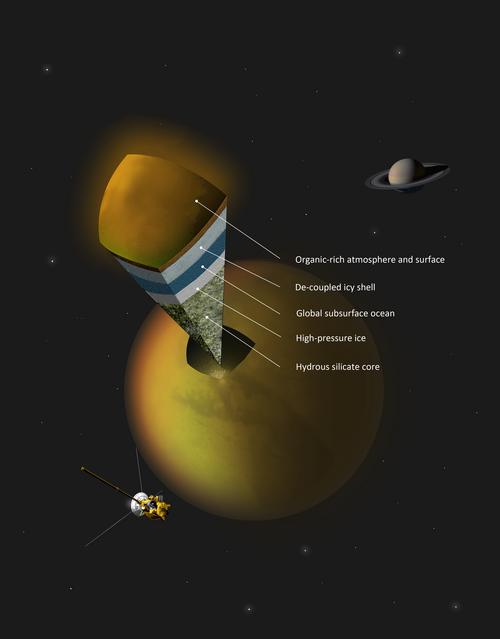
The artistic view above unveils the hypothetical internal structure of Saturn's largest moon. A global subsurface ocean can be found between the external icy shell and an internal layer of high-pressure ice. The hypothesis for a subsurface ocean is strengthened by the Cassini data from the Radio Science Experiment. Image Credit: A. Tavani.
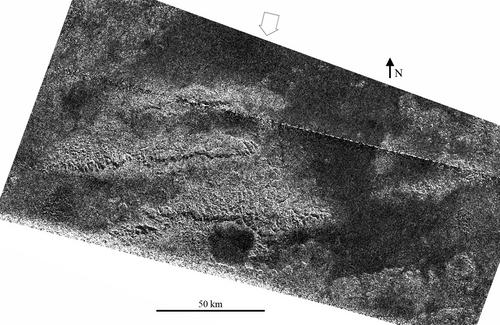
The radar view above obtained with the Radar Mapper of the Cassini probe during the Titan flyby of May 12, 2008 reveals the area of the bright Xanadu with three linear and parallel ridges suggesting tectonic movements. This is a sign of crustal instability. The instability may be related to the hypothetical subsurface ocean of liquid water. Image Credit: NASA/JPL.
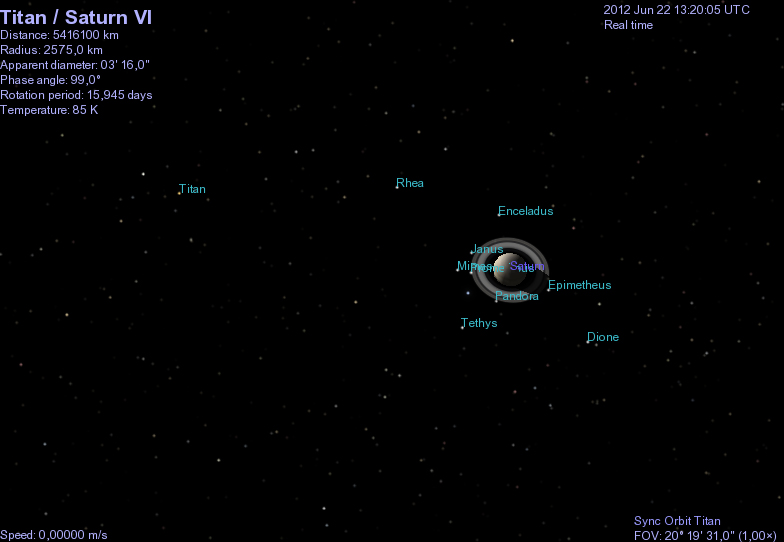
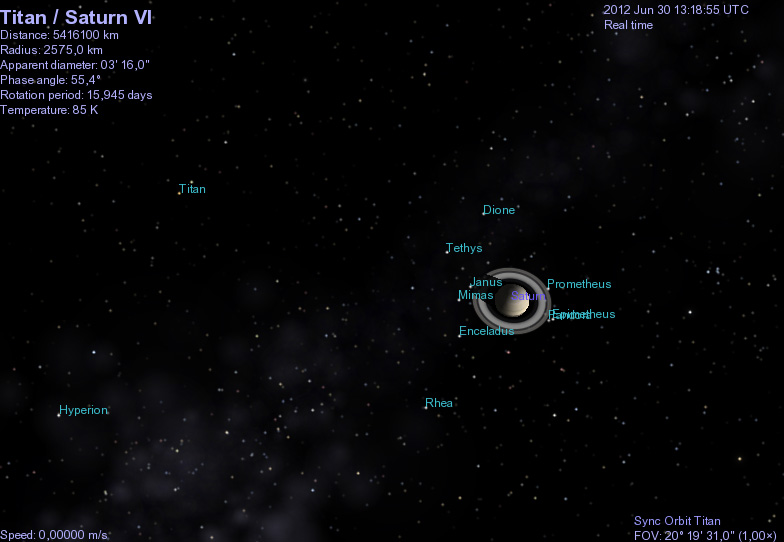
The simulated views of the Saturn System above, derived from the Celestia program, provide us with an insight into the potential tides undergone by Titan in the Saturn System due to the orbital configuration and the gravitational attraction of Saturn, the Sun and the other moons. The upper simulated view shows the orbital configuration of Titan on June 22, 2012. The lower simulated view shows the orbital configuration of Titan on June 30, 2012. Image Source: Celestia Program. Post Scriptum: The texture of the atmosphere of Titan was incorporated by Marc Lafferre into these images.
- To get further information on that news, go to: http://saturn.jpl.nasa.gov/news/newsreleases/newsrelease20120628.
June 15, 2012: VIMS Data from Cassini Suggest the Presence of Tropical Lakes on Titan
Before the start of the Cassini-Huygens mission in the Saturn System, some hypotheses suggesting the presence of oceans or seas on Saturn's largest moon, Titan, had been put forward. Indeed, infrared or near-infrared data reveal dark or low-albedo areas concentrated in the low latitudes of the Opaque Moon. A brightness contrast can be observed between the Tropical areas and higher latitudes which appear brighter.
Before the atmospheric descent and the landing of the Huygens probe on January 14, 2005 in the Adiri/Shangri-La region, some scientists believed that the dark equatorial or tropical areas represented seas or oceans of liquid methane or ethane. Was Titan an "Ocean Moon"? The aerial views from the Huygens probe revealed bright hills made of fractures or drainage channels and a dark, orange plain with bright patches. The hypothetical sea was not present during that Summer period in the southern hemisphere.
The Huygens probe landed into what appeared to be a dried-up river made of eroded stones or pebbles. As a result, one can imagine periodic rainfalls of methane or ethane which fuel the brooks or rivers in the low latitudes of the Orange Moon.
Are there long-standing methane lakes or puddles in the low latitudes or the tropical areas of Titan? The question is still debated even if the radar data obtained with the Radar Mapper of the Cassini spacecraft until now are not convincing regarding the hypothesis of wetlands in the low latitudes of the moon.
The first body of liquids clearly identified on Titan was Ontario Lacus, a big lake or a small sea located in the high latitudes or in the polar area of the southern hemisphere. Ontario Lacus was first identified in 2005. The lake appeared as a dark, uniform patch in the infrared or near-infrared images obtained with the VIMS of the Cassini probe. The area also revealed a high concentration of dynamic cloud systems implying a methane/ethane cycle similar to the water cycle on Earth with evaporation and precipitation processes.
The radar data acquired with the Radar Mapper of the Cassini spacecraft revealed, as soon as 2005, "Cat Scratches" or Seif dunes in the dark low latitudes of the Orange Moon. It proved that the low-albedo or low-reflectivity areas couldn't be automatically associated with seas or lakes of hydrocarbons such as methane or ethane.
In fact, the radar images of the low latitudes show that the dark areas of the low latitudes are dominated by Seif dunes or linear and parallel dunes extending over long distances and shaped by prevailing winds. Can there be lakes, rivers, puddles, oases or caves in a dune field area ?
Besides, the radar data of the Cassini probe have allowed us to identify a significant contrast between the Tropical region and the polar regions which harbour lakes, seas and rivers. The radar data have shown that the high latitudes of the northern hemisphere are dominated by numerous lakes, seas and rivers. Kraken Mare, Ligeia Mare and Punga Mare appear to be the largest bodies of liquids in the north polar region. Kraken Mare is also clearly identified in the infrared and near-infrared images.
The first radar views of the north polar region were taken during the Winter period in the northern hemisphere. One Titanian year lasts approximately 29.5 Terrestrial years and each season lasts approximately seven Terrestrial years. The Winter season in the northern hemisphere and the Summer season in the southern hemisphere ended in August 2009 with the Equinox which marked the start of the Spring season in the northern hemisphere and of the Autumn season in the southern hemisphere.
It appears that the highest concentration of liquids is found in the north polar region. Is it related to the fact that the area has just undergone the Winter period ? Is it related to orbital parameters such as the variations in the distance of Titan from the Sun and the inclination of the rotational axis ? Or are there internal sources which fuel the lakes or the seas ?
Global circulation models suggest a net evaporation of liquid methane or ethane in the low latitudes and a migration of the volatile hydrocarbons to the polar areas via winds. The lower temperature in the polar areas enables methane or ethane molecules to condense to form clouds which then generate rain resulting in the formation of polar lakes or seas.
The giant ethane cloud system observed in late 2006 with the VIMS instrument of the Cassini spacecraft in the infrared or near-infrared spectrum may have taken shape thanks to relatively low temperatures and the migration of volatile hydrocarbons from lower latitudes.
A new finding based on VIMS data from the Cassini probe and proposed by Caitlin Griffith and her team in the journal Nature on June 13, 2012 suggests the presence of Tropical lakes or puddles in the dark areas of the Tropical region. The presumed lakes or wetlands are found in the dark region known as Shangri-La, not far from the bright Adiri and the Huygens landing site.
The team led by Caitlin Griffith who is also a Cassini team associate at the University of Arizona, Tucson unveils what may be a lake about half the size of Utah's Great Salt Lake. This hypothetical Tropical lake is 60 kilometers long and 40 kilometers wide with a mean depth of at least 1 meter.
How can we explain the presence of wetlands, lakes or rivers in the low latitudes of Titan where Seif dunes dominate the landscape and where very few sporadic clouds have been observed until now ? A few transient cirrus-like clouds have been identified in the Tropical areas at mid-latitudes since the arrival of the Cassini-Huygens spacecraft in 2004. Those clouds may be too thin to generate methane or ethane rain.
However, recent infrared or near-infrared observations, performed in 2010, a little after the Spring Equinox in the northern hemisphere and the Autumn Equinox in the southern hemisphere, revealed a large concentration of dynamic clouds in the low latitudes of the moon. Some portions of the dark area became darker or brighter implying the action of rainfall.
Therefore, one can assume the formation of lakes in the low latitude areas via rainstorms. But how stable will the lakes be ? What will be the rate of evaporation ? Is there a balance between evaporation and precipitation ? The origin of the methane observed on this enigmatic moon may be found inside the moon because methane molecules tend to be broken apart by ultraviolet light over time engendering new molecules like C2H2, CH, C2H4, HCN or other organic molecules.
Are there geysers, cryovolcanic sources which fuel the observed lakes or seas ? Caitlin Griffith pointed out: "A likely supplier is an underground aquifer."..."In essence, Titan may have oases." She advanced: "An aquifer could explain one of the puzzling questions about the existence of methane, which is continually depleted."
Methane can reach up to 5% of the atmosphere near the ground. Is there a subsurface layer of liquid methane or liquid hydrocarbons ? Some studies have shown that there are high concentrations of tholins or organics such as benzene. The landing of the Huygens probe in the Adiri/Shangri-La region engendered the vaporization of methane from the soil suggesting a humid or damp area.
Caitlin Griffith explained: "Methane is a progenitor of Titan's organic chemistry, which likely produces interesting molecules like amino acids, the building blocks of life."
The presumed Tropical lakes unveiled by the VIMS images have remained since the arrival of the Cassini/Huygens spacecraft in 2004. So, one may advance an internal source for the lake if the evaporation rate is relatively high and if rain is infrequent.
Linda Spilker, the Cassini project scientist based at NASA's Jet Propulsion Laboratory, Pasadena, California pointed out: "We had thought that Titan simply had extensive dunes at the equator and lakes at the poles, but now we know that Titan is more complex than we previously thought."
The presence of dunes in the dark areas of the low latitudes demonstrates that the humidity levels in the low latitudes are low. Jonathan Lunine of Cornell University in Ithaca, New York advanced: "The equatorial belt is like a desert on Earth, where evaporation trumps precipitation." However, like in any desert, one may find oases of liquids replenished by internal sources.
Jonathan Lunine argued: "There may be organic chemical processes that occur in liquid hydrocarbons that could lead to compounds analogous to proteins and information-carrying molecules."... The presence of a solvent like liquid methane or liquid ethane pushes us into advancing the astrobiological hypothesis with methane-based lifeforms.
Jonathan Lunine argued: "There might be a kind of life that works in liquid hydrocarbons." He concluded: "There's a place on Titan named Xanadu, and if you go back to the Coleridge poem on Xanadu, he talks about 'caverns measureless to man'."
The methane cycle on Titan is far from being clearly understood. The Titanian year is extremely long and Titan has been studied via the Cassini spacecraft instruments for a little bit more than one Titanian season. That's not enough to clearly understand the dynamics of the meteorology, the climate and the atmosphere.
Moreover, there may be internal sources for the methane present in the atmosphere and in the lakes and seas which complicates the modelling of the methane cycle and the meteorology.
A new study attempts to estimate how long the methane activity has been operating on the Orange Moon. The results are proposed in two papers of the April 20 issue of the Astrophysical Journal.
The scientists determined the concentration of carbon 12 and carbon 13 in the atmosphere to predict how long the atmospheric chemical factory has been running. The age of the factory will depend on the way the concentration of heavy methane changes over time.
Conor Nixon of the University of Maryland, College Park advanced: "Under our baseline model assumptions, the methane age is capped at 1.6 billion years, or about a third the age of Titan itself."..."However, if methane is also allowed to escape from the top of the atmosphere, as some previous work has suggested, the age must be much shorter -perhaps only 10 million years- to be compatible with observations."
The assessment of the age of the methanosphere will also depend on the proportion of the methane molecules emerging from the underground or the interior of the Orange Moon. Conor Nixon pointed out: "However, if the methane has been continuously replenished from a source, then its isotopes would always appear 'fresh' and we can't restrict the age in our model."
The methane rising from the underground may derive from methane clathrates and cryovolcanic eruptions of presumed water-ammonia slurry may be accompanied by methane molecules. Scientists determined the concentration of the heavy methane from measurements by the Ion and Neutral Mass Spectrometer, in particular.
Kathleen Mandt of the Southwest Research Institute, San Antonio explained: "We compute that, even if methane has been replenished from the interior over time to match or exceed the amounts fed into the atmospheric chemical factory, the process must have been running for a maximum of one billion years." She added: "If the process had started any earlier, we would see a build-up of methane in the lakes on the surface and in the atmosphere beyond what is observed today."
To sum up, the study upon the methane age from the Titanian atmosphere suggests that the methanosphere or the atmospheric methane observed today is less than one billion years old which is far less than the estimated age of Saturn's largest moon.
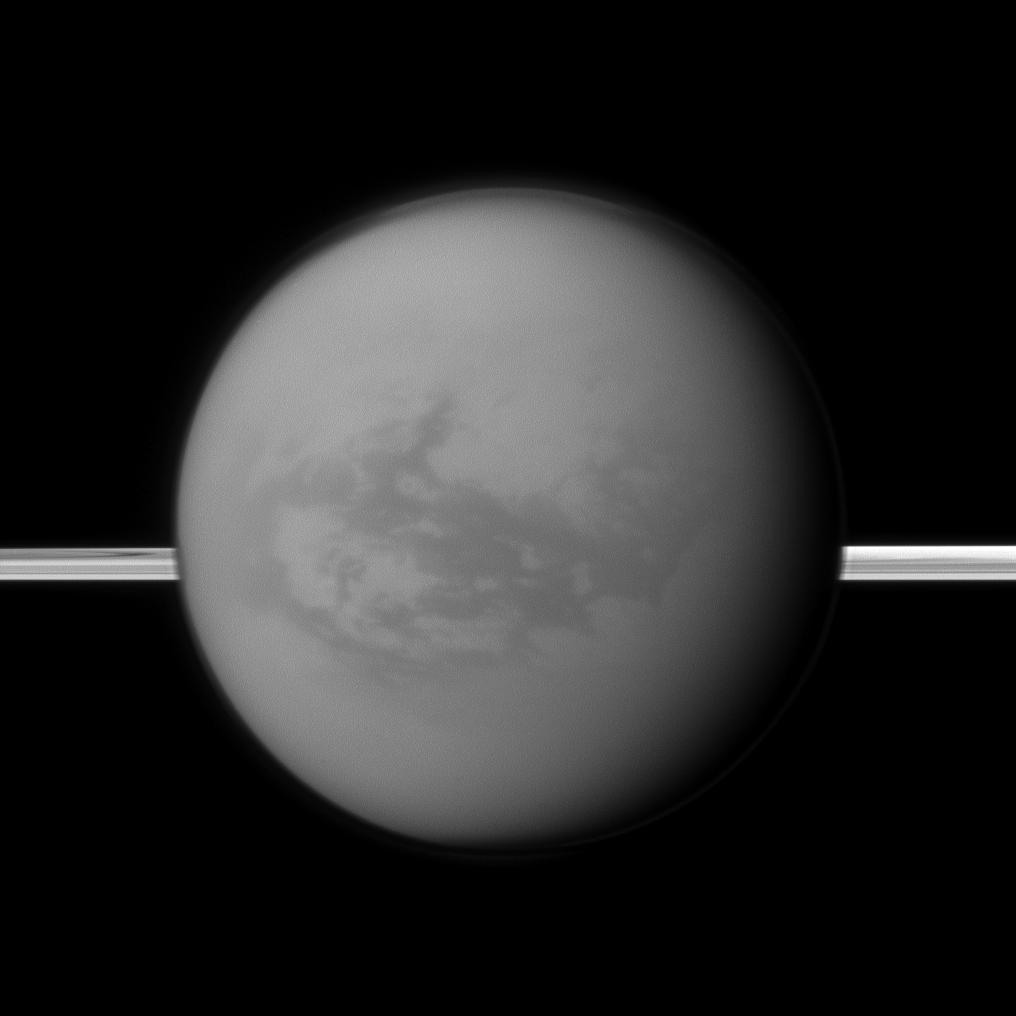
The near-infrared view of Saturn's largest moon above, obtained on August 9, 2011 with the Narrow-Angle Camera of the Cassini spacecraft, reveals the dark Shangri-La, a region close to the bright Adiri, located east of the landing site of the Huygens probe. The dark equatorial and tropical areas appear to be dominated by Seif dunes or linear and parallel dunes extending over long distances but oases of liquid hydrocarbons such as methane and ethane may exist in the area as some observations suggest. Image Credit: NASA/JPL-Caltech/Space Science Institute.
|
|
|
|
| The artistic view in the upper part of the table
unveils a low latitude area of Titan suspected to harbour rivers or
pools of liquid hydrocarbons such as methane and ethane. The view in the
lower part of the table corresponds to a portion of a radar swath taken
from the Radar Mapper of the Cassini spacecraft on October 28, 2005. The
arrow indicates the direction of the virtual camera unveiling the
artistic image. The dark sinuous landcape feature may correspond to a
drainage channel . Post Scriptum: The grey arrow was incorporated by
Marc Lafferre into the radar portion to indicate the direction of
the virtual camera showing the artistic view. |
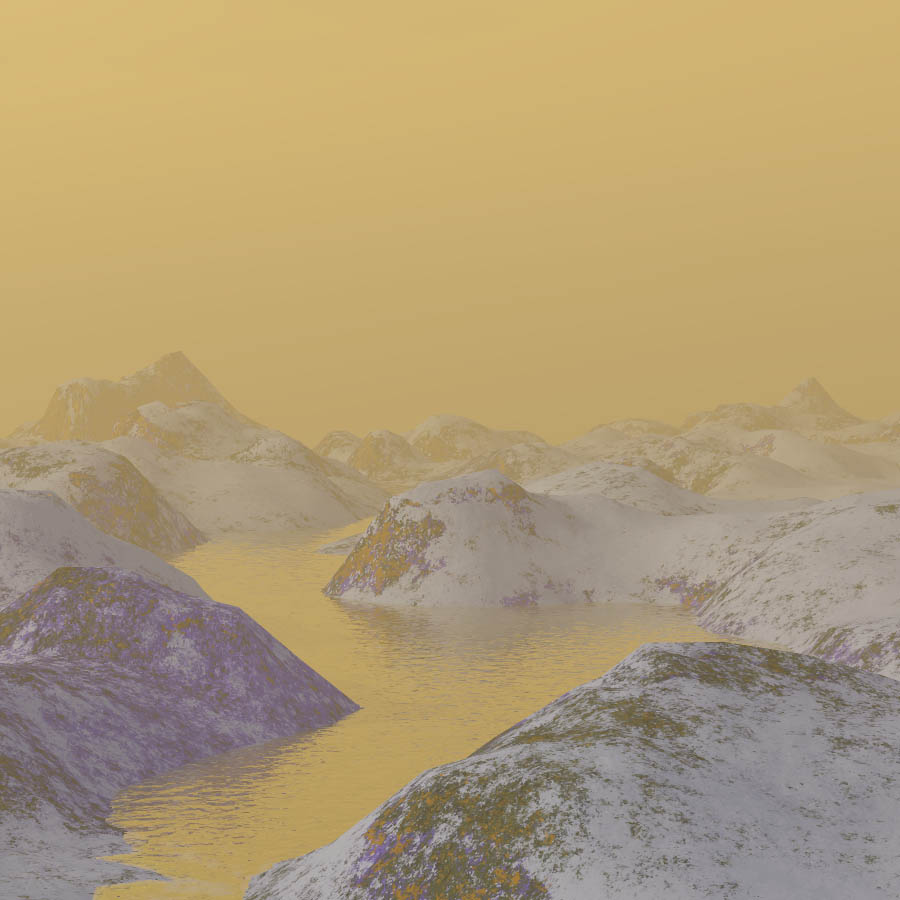
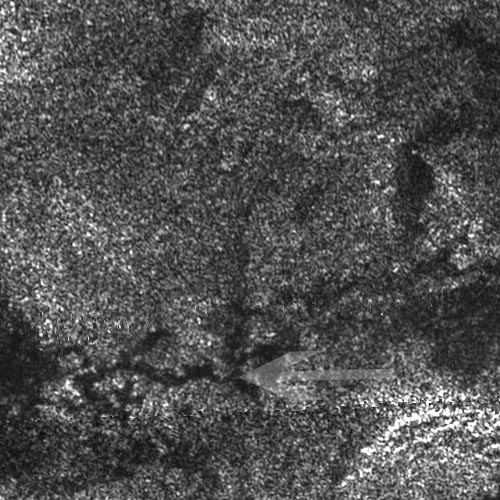
- To get further information on that news, go to: http://saturn.jpl.nasa.gov/news/newsreleases/newsrelease20120613, http://saturn.jpl.nasa.gov/news/cassinifeatures/feature20120424 and http://www.nature.com/news/tropical-lakes-on-saturn-moon-could-expand-options-for-life-1.10824.
April 26, 2012: The Lake Ontario Lacus on Titan May be Drier than Expected and Shows Similarities with the Etosha Mudflat in Namibia
Planetary scientists have long suspected the existence of oceans of hydrocarbons such as methane, ethane or propane on Saturn's largest moon Titan. The near-infrared views obtained with the "Visual and Infrared Mapping Spectrometer" of the Cassini spacecraft which arrived in the Saturn System in mid-2004 clearly revealed dark or low-albedo regions in the low latitudes of the Orange Moon and bright or highly reflective regions at higher latitudes.
This landscape contrast had led scientists to advance the hypothesis of oceans of methane or ethane in the low latitudes of the Opaque Moon where dark areas dominate. This hypothesis was shared, for instance, by the French astronomer André Masclet. However, on January 14, 2005, the Huygens probe which plunged into the atmosphere to land into the Shangri-La/Adiri region unveiled a relatively dry landscape with dried-up drainage channels on the bright hills of Adiri.
The images taken from the landing site, located in the low latitudes of the moon, revealed what might be a dried-up river made of pebbles or eroded stones. Later, in 2005, the radar images obtained with the Radar Mapper of the Cassini probe revealed strange linear and parallel features in the dark regions of the low latitudes of Titan. Planetary scientists called it "Cat Scratches".
Thanks to the radar images, we know, now, that the dark regions of the low latitudes of the Orange Moon are dominated by Seif dunes or linear and parallel dunes which extend over long distances. Those Seif dunes appear to be shaped by prevailing winds. They can be deflected by topographic obstacles or bright features. They are reminiscent of the Seif dunes in the Namib desert in Namibia.
The first pool of liquids clearly identified on Saturn's largest moon was found in the high latitudes of the southern hemisphere, on the basis of a near-infrared image taken in 2005. This kidney-shaped lake was named Ontario Lacus. Later, the radar images brought clearer data on the shape and the characteristics of the lake.
A radar image of the lake was captured, for instance, on January 12, 2010 with the radar instrument of the Cassini spacecraft. This image shows that Ontario Lacus covers an area approximately 140 by 47 miles or 230 by 75 kilometers. Some dark drainage channels can be noticed and the depth of the lake seems to vary.
The southern portion of the dark Ontario Lacus appears to be less humid than the northern portion of the lake since reflective areas can be well discerned in the southern portion of the depression. As planetary scientists suggest, the southern boundary of the depression unveils strong evidence for long-standing channels carving the lake bed.
A new study led by Thomas Cornet of the Université de Nantes, France, a Cassini associate confirms the idea that the dark Ontario Lacus may not be completely filled with liquid hydrocarbons such as ethane and methane. The study entitled "Geomorphological significance of Ontario Lacus on Titan: Integrated Interpretation of Cassini VIMS, ISS and RADAR data and comparison with the Etosha Pan (Namibia)" is presented in the volume 218, issue 2 of Icarus in April 2012.
According to Thomas Cornet and his team, Ontario Lacus lies in an arid or semi-arid zone, in a flat basin similar to the Etosha Basin, where the Etosha pans are found and it is only partially covered by liquids, contrary to what had been previously thought. The liquids of the lake may engender dissolution processes within the depression which may lead to an enlargement of the lake.
The area may be saturated with liquid hydrocarbons such as ethane, methane or even propane and the depression may drain and refill from below, exposing liquid portions ringed by materials like saturated sand or mudflats. Thomas Cornet claimed: "We conclude that the solid floor of Ontario Lacus is most probably exposed in those areas."
The team of Thomas Cornet draws a parallel between Ontario Lacus and the Etosha salt pan on Earth, in Namibia which is mostly dry. The Etosha salt pan is a lake bed that can be fed, during the rainy season with a shallow layer of water that emerges from the ground or the underground. The evaporation processes of this layer of water leave sediments like tide marks revealing the previous extent of the lake.
Bonnie Buratti, a co-author of the paper and a Cassini team member based at NASA's Jet Propulsion Laboratory in Pasadena, California advanced: "Some of the things we see happening in our backyard are right there on Titan to study and learn from."..."On Earth, salt pans tend to form in deserts where liquids can suddenly accumulate, so it appears the same thing is happening on Titan."
Saturn's largest moon reveals a complex cycle of hydrocarbons which may be intimately linked to seasonal factors. The radar, infrared or near-infrared data have allowed us to determine that the liquid bodies are mostly found in the high latitudes of the northern hemisphere and the southern hemisphere.
Dynamic cloud systems have been observed in the area of Ontario Lacus implying precipitation and evaporation processes. A giant ethane cloud system engulfing the north polar region was also found in 2006. The largest concentration of lakes, seas and rivers appears in the high latitudes of the northern hemisphere.
This asymmetry in the distribution of liquid bodies between the northern hemisphere and the southern hemisphere may be explained by orbital parameters and seasonal factors which influence the amount of solar energy received by each hemisphere. A Titanian year lasts approximately 30 Terrestrial years and each season lasts about 7 Terrestrial years.
The Summer season in the southern hemisphere ended in August 2009 with the equinox which marked the start of the Autumn season. This equinox marked the end of the Winter season and the beginning of the Spring season in the northern hemisphere. Will the level of the liquid of Ontario Lacus rise in the coming years as the Winter season in the southern hemisphere is approaching?
A study entitled "Shoreline retreat at Titan's Ontario Lacus and Arrakis Planitia from Cassini Imaging Science Subsystem observations", proposed by Elizabeth P. Turtle and her team (J.E. Perry, A.G. Hayes and A.S. McEwen) and appearing in the Volume 212, Issue 2 of Icarus in April 2011 showed that observations from the Imaging Science Subsystem of the Cassini spacecraft reveal that a portion of the shoreline of Ontario Lacus had retreated by several kilometers.
On that basis, one may argue that the area may have undergone less precipitation than evaporation between the observations from the Cassini spacecraft. However, there may be absorption processes through the floor of Ontario Lacus similar to those found, for instance, in the plateau of Calern near the village of Caussols in the south east of France.
Therefore, the hydrocarbon cycle based on methane, ethane and even propane may be the outcome of a complex interaction between the atmosphere, the surface and the subsurface. What are the properties of the floor which covers the Ontario Lacus depression? Is it porous? Is the subsurface saturated with ethane or methane? Are there dissolution processes?
A comparative analysis between lakes, humid areas or landscape features on Earth and on Titan allows us to put forward strong hypotheses on the characteristics of the topographic features we observe on Titan via the VIMS or radar data.
Nicolas Altobelli, ESA's Cassini-Huygens project scientist pointed out: "These results emphasize the importance of comparative planetology in modern planetary sciences: finding familiar geological features on alien worlds like Titan allows us to test the theories explaining their formation."
Titan remains a relatively dry world. Very few clouds have been identified in the equatorial and tropical regions of the Opaque Moon and the largest concentrations of clouds have been found in the polar regions, especially in the high latitudes of the northern hemisphere. The dark low-latitudes seem to be devoid of lakes, seas or rivers and are dominated by linear and parallel dunes extending over long distances.
The cloud cover of the Earth generally exceeds 50% but on Titan, this cloud cover likely represents less than 1% as the VIMS observations suggest. Ontario Lacus is probably located in one of the most humid areas on Titan but it may lie in a relatively dry area in terms of Terrestrial standards.
As a result, a parallel is drawn between the Etosha Pan located in the Kalahari Basin in the north of Namibia and Ontario Lacus. The Etosha Pan is a mudflat representing a surface area of about 75 by 40 miles or 120 by 65 kilometers. Ontario Lacus has probably closer characteristics to the Etosha Pan, the Dead Sea, Lake Chad or the Aral Sea than Lake Ontario in North America, in terms of depth and precipitation.
|
|
|
|
| The two images above show the area of Ontario Lacus on
Titan and the area of the Etosha Pan on Earth in the north of Namibia,
unveiled with the same scale. The image in the upper part of the table
corresponds to a radar view of Ontario Lacus obtained with the Radar
Mapper of the Cassini spacecraft on January 12, 2010. The image in the
lower part of the table corresponds to a Google Earth view of the Etosha
Pan area. The team of Thomas Cornet suggests that there are some
similarities between Ontario Lacus and the Etosha Pan since some parts
of Ontario Lacus may be relatively dry and may resemble a mudflat.
Post Scriptum: The colour has been removed from the original Google
Earth view of the Etosha Pan area. The radar view of Ontario Lacus has
been resized by Marc Lafferre so that the scale is the same in each view. |
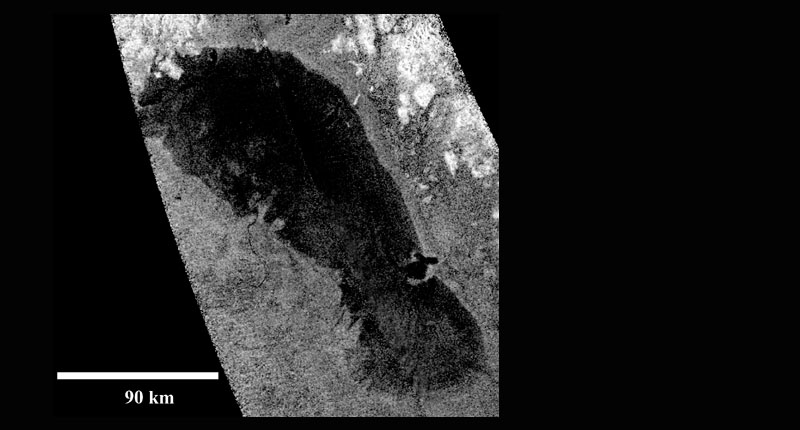
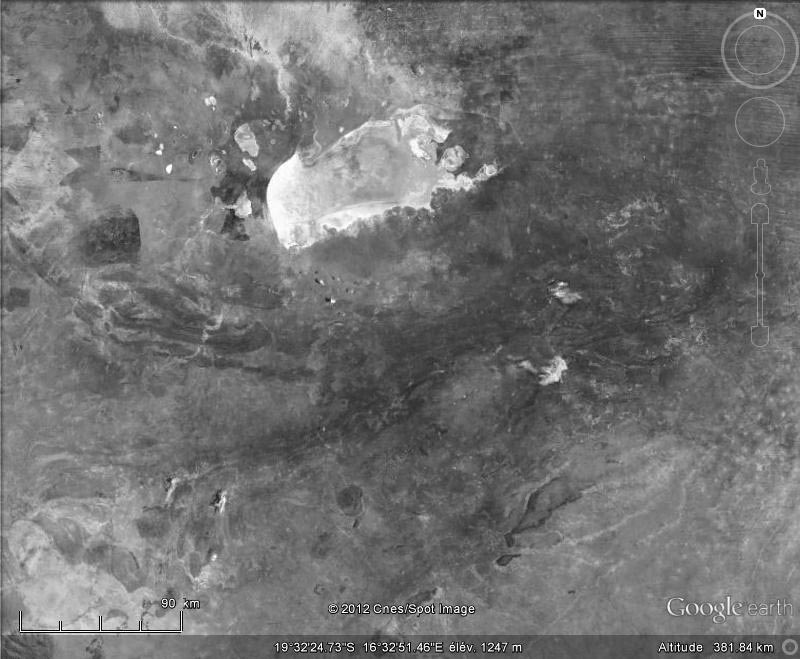
|
|
|
|
| The artistic image in the upper part of the table shows
the giant lake Ontario Lacus from a virtual camera located on the
shoreline in the south east part of the lake. The lower view, which
unveils a radar portion of the Ontario Lacus area acquired from the
Radar Mapper of the Cassini spacecraft on January 12, 2010, incorporates
a grey arrow indicating the orientation of the virtual camera in the
artistic view. One can notice, on the horizon, that some landscape portions, in the south part of the lake, emerge from the liquid. The south part of the lake seems less humid and less deep than the north part of the lake. A team led by Thomas Cornet believes that it may look like a mudflat similar to the Etosha Pan in the north of Namibia. Post Scriptum: The
grey arrow was incorporated by Marc Lafferre into the original radar
image of Ontario Lacus. |
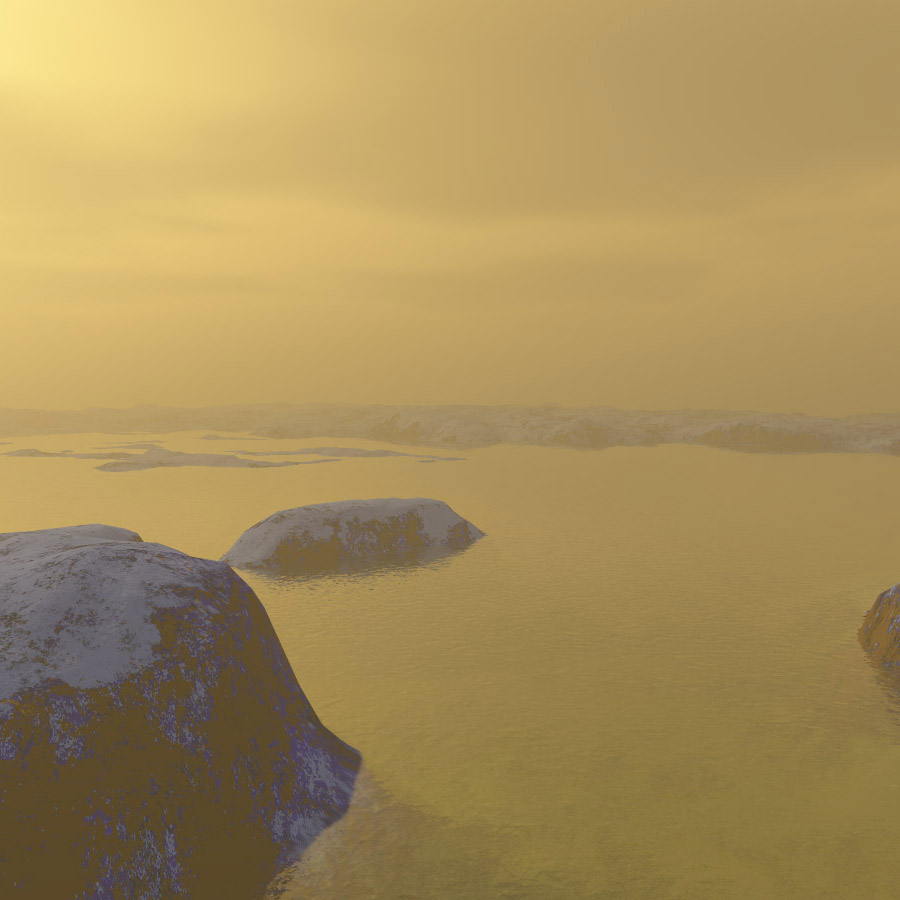
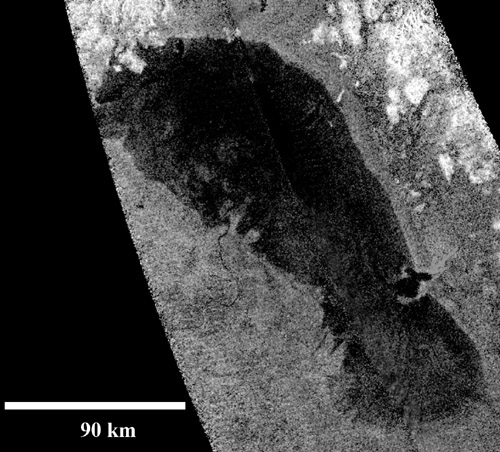
- To get further information on that news, go to: http://saturn.jpl.nasa.gov/news/cassinifeatures/feature20120419, http://www.sciencedirect.com/science/article/pii/S0019103512000280 and http://www.sciencedirect.com/science/article/pii/S0019103511000546.
March 31, 2012: Cassini Observations Suggest Very Infrequent Rainfall on Titan
Since the arrival of the Cassini/Huygens spacecraft in the Saturn System in mid-2004, the landscape, the climate and the meteorology of the Opaque Moon have been intensively studied on the basis of multiple instruments of the Cassini probe and the Huygens probe.
The radar data allows us to observe the topography of Titan. The near-infrared data allows us to identify landscape features as well as clouds. The observations reveal surprising similarities between the environment of Saturn's largest moon and the environment of the Earth.
The Huygens probe which landed in the Shangri-La/Adiri area on January 14, 2005 revealed dark drainage channels on bright hills during its atmospheric descent. The probe probably landed on a dried-up river. The images obtained from the surface unveiled pebbles or eroded stones around the probe.
The VIMS (Visual and Infrared Mapping Spectrometer) data as well as the radar data acquired with the radar mapper of the Cassini spacecraft have clearly revealed mountains, rivers, lakes, seas, islands or canyons. It appears that the liquid bodies are concentrated in the high latitudes or the polar regions of the moon.
Ontario Lacus was the first lake or sea clearly identified on Titan in 2005 thanks to the near-infrared data of the VIMS onboard the Cassini spacecraft. Later, in 2006, the radar data showed a pleiade of lakes, seas and rivers in the high latitudes of the northern hemisphere.
Kraken Mare, Ligeia Mare and Punga Mare appear to be the most famous bodies of liquids identified in the high latitudes of the northern hemisphere. Likewise, the cloud systems are mostly found in the polar regions.
Dynamic cloud systems have been found in the area of Ontario Lacus during the Summer season in the southern hemisphere. A giant ethane cloud system engulfing the north polar region was also found in 2006 during the end of the Winter season in the northern hemisphere.
The meteorology of the Orange Moon appears to be dominated by methane and ethane. The atmosphere of Titan is mostly composed of molecular nitrogen which represents approximately 98% of its composition and methane can reach up to 5% of its composition. There is a methane cycle between the ground and the atmosphere which shows striking similarities with the water cycle observed on the "Blue Planet".
There are rainfalls, evaporation processes, clouds, ponds, lakes, rivers or seas. Those processes are closely related to a limited amount of energy on the soil and in the atmosphere. The Huygens probe recorded a surface temperature of about -179 degrees Celsius, -290 degrees Fahrenheit or 94 Kelvin. At those temperatures, water will appear in its solid form, as water ice, and methane and ethane can be found in their liquid form.
The distribution of lakes, seas and rivers on Titan may be closely related to seasonal factors. As the Winter season approaches in the southern hemisphere, the amount of clouds may increase engendering more precipitation and the level of the lakes, seas and rivers may increase.
At the moment, the north polar region appears to be the most humid area on Titan with the biggest known body of liquid, Kraken Mare. This asymmetry in the distribution of lakes and seas on the Orange Moon may also be explained by orbital parameters such as the inclination of the rotation axis and the variation of the distance of the moon to the Sun. These factors will strongly influence the amount of energy reaching the soil.
The equatorial and tropical regions, dominated by Seif dunes or parallel dunes extending over long distances appear particularly dry. No lakes or rivers have been clearly identified in the low latitudes even if multiple fractures or dried-up channels have been observed in the radar images of the low-latitude region.
Doctor Ralph Lorenz and Elizabeth P. Turtle from the Johns Hopkins Applied Physics Laboratory in Laurel, Maryland demonstrated, during the 43rd Lunar and Planetary Science Conference in 2012 that the mean cloud cover on Titan is particularly weak and that precipitation may be extremely rare in some parts of the Orange Moon such as in the equatorial and tropical regions.
In the low latitudes of Titan, it may periodically rain for brief periods of time but it may be similar to monsoon events on Earth with very strong rainfall which can feed or engender deep lakes or rivers.
Large cloud systems have been recently observed in the low latitudes of Titan in 2010, a little after the Spring Equinox in the northern hemisphere. Those cloud systems may have generated rainfalls of methane or ethane as the near-infrared images of the areas suggest. Some regions appeared darker or brighter after the storm. Those cloud systems forming and moving in the low latitudes may be explained by seasonal changes.
The drier part of Titan may receive rainfall every 1,000 years, roughly speaking. If the typical interval between rain storms on Earth is around one week, the typical interval between rain storms on the Orange Moon may be between 100 and 1000 years. The average cloud cover of our Blue Planet is comprised between 50% and 65% whereas the cloud cover of Titan is approximately 0.3% on the basis of a ground-based spectroscopic monitoring campaign studying the atmosphere on 138 nights over 2.2 years.
Observations from the Keck telescope on 16 nights during the 2001-2003 period revealed a cloud coverage ranging from 0.2 to 0.6%. In fact, it rains only between 0.01% and 0.1% of the time. But the probability of rain in the south polar region and in the north polar region may be significantly higher than in the equatorial and tropical region.
A new mission to Saturn's largest moon is envisaged by scientists for the near future. A mission called TiME or Titan Mare Explorer corresponding to the category of NASA Discovery missions would be launched for a landing, in 2023, in the north polar lake Ligeia Mare. The parachuted probe would likely spend approximately 1 hour descending through the troposphere of the moon.
The probability of encountering a rainstorm for the probe would be lower than 0.2%. The north polar region will be in the Summer period in 2023 at the time of the expected landing.
The TiME probe, generated by nuclear power, would spend 96 days or 6 Titan days on Ligeia Mare. The probe would benefit from a full diurnal cycle at Ligeia Mare since the Sun will be positioned between +20 degrees and -6 degrees of elevation.
Will the probe detect or see rain? The probability of rain hitting the lander may be around 50% thanks to the relatively long duration of the mission. The probe may operate during 2500 hours or more than 100 Terrestrial days. The camera of the probe could identify nearby rainfall approximately 5 times during the campaign. The spacecraft will be able to see cloud formation, rain shafts and even methane rainbows.
If we assume that the rain shafts are 10 km wide and that they are observable at distances of about 20 km, then the area observable is a circle of approximately 1,200 km². That's why the chance of finding rainfalls is relatively high. The estimates unveiled by Ralph Lorenz and Elizabeth Turtle suggest that regions near the poles receive rainfall between 10 and 100 hours every Titanian year which corresponds to almost 30 Earth years.
How volatile are the lakes, seas and rivers in the north polar region? As the Spring season advances in the northern hemisphere, the great lakes or seas Kraken Mare and Ligeia Mare come to light allowing near-infrared observations which enable Cassini scientists to monitor the size and the evolution of the liquid bodies as well as the dynamics of cloud systems in the area. Kraken Mare and Ligeia Mare may appear smaller or see their level diminish during the next Summer season in the northern hemisphere of Titan.
Due to the complexity of the climate and meteorology of Titan and due to the length of a Titanian season (around 7 Terrestrial years) or a Titanian year (around 30 Terrestrial years), scientists need to continue gathering meteorological or atmospheric data in the coming years to improve their climate and meteorological models of the Orange Moon. The destination of the future lander of Titan may change depending on the evolution of the meteorological processes in the coming years.
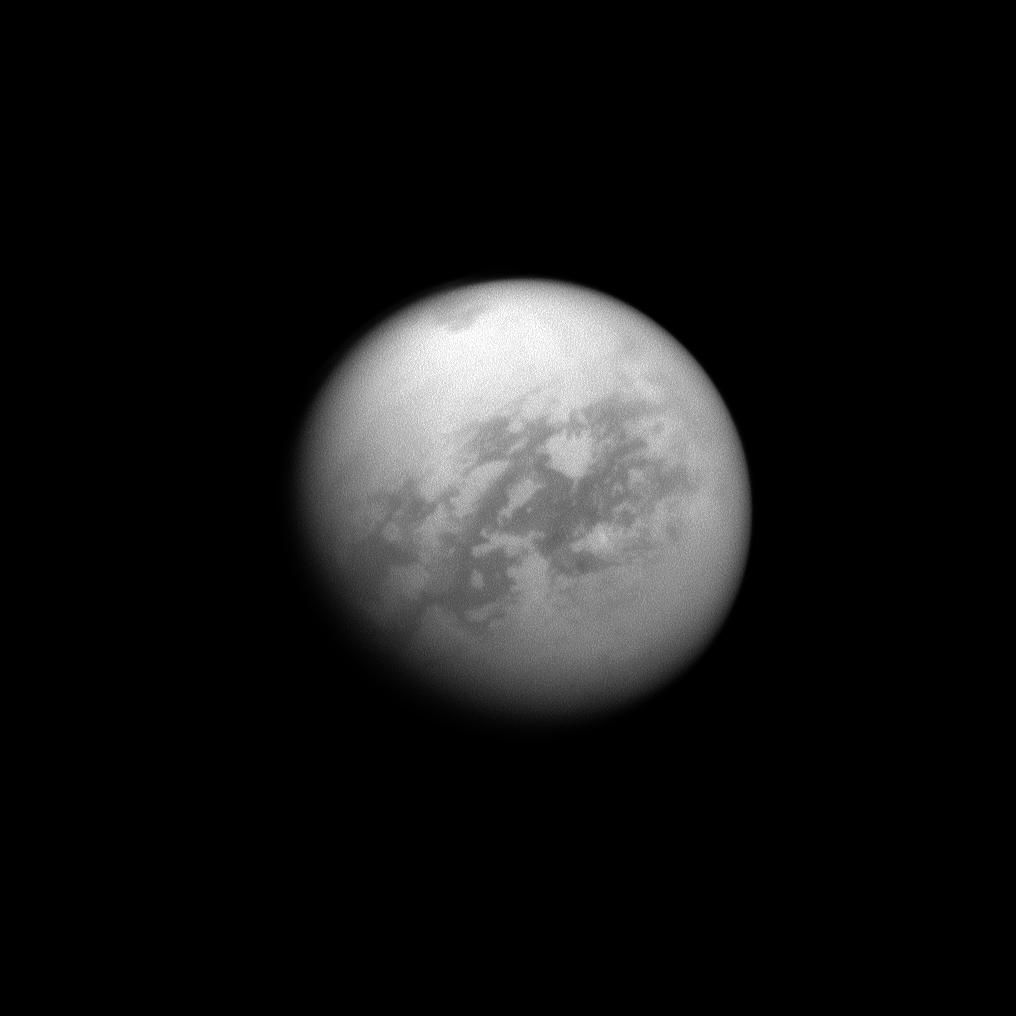
The near-infrared view above, taken with the VIMS instrument of the Cassini probe on September 14, 2011, reveals some surface features of Saturn's largest moon Titan. The low latitudes tend to be dominated by Seif dunes or linear and parallel dunes extending over long distances in the low-albedo areas. The dark area of the north polar sea Kraken Mare can be observed in the upper part of the disc. The bright areas are likely devoid of any liquid bodies. The equatorial and tropical regions may be relatively dry due to very infrequent rainfall. Image Credit: NASA, JPL-Caltech/Space Science Institute
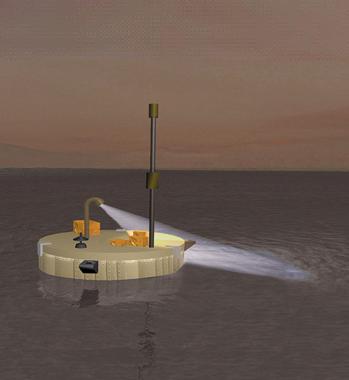
The artistic view above represents the probe of a project, called Titan Mare Explorer or TiME, in the north polar lake Ligeia Mare of the Orange Moon. This probe could be sent for an expected landing in 2023 into this enigmatic lake. Image Credit: TSSM NASA/ESA joint summary report

The image above corresponds to an artistic view of a hypothetical probe floating in one of the largest bodies of liquids in the north polar region of Titan, Punga Mare. One can notice a foggy environment and a relatively quiet lake with small waves. The depth of the lake, likely made of hydrocarbons such as methane and ethane is very low here. One can clearly discern the bottom of the lake in this view, close to the shoreline. The probe emits a powerful light to explore the area which receives a relatively low amount of solar radiation during this period of autumn. Image Credit: Marc Lafferre, 2012.
- To get further information on that news, go to: http://www.lpi.usra.edu/meetings/lpsc2012/pdf/2472.pdf, http://www.universetoday.com/94321/rare-rain-on-titan-once-every-1000-years and http://www.astrobio.net/pressrelease/4651/rare-rains-on-titan.
February 25, 2012: A New Study Shows North Polar Clouds On Titan Thinning Out From Winter To Spring
Planetary scientists focus their attention on the study of the geology, climate, meteorology and atmosphere of Saturn's largest moon Titan because Titan is a complex world revealing striking similarities with the Blue Planet.
We've identified mountains, canyons, lakes, seas, rivers and massive clouds on the Opaque Moon. The methane cycle on Titan is reminiscent of the water cycle on the Earth. The atmosphere of Titan is reminiscent of the atmosphere of the Early Earth. The chemistry of organics and hydrocarbons on Titan is intriguing because it can lead to the formation of complex molecules.
Therefore, the Orange Moon Titan is of astrobiological interest. The radar and near-infrared data have revealed lakes, seas and rivers in the high latitudes of the northern hemisphere and the southern hemisphere.
Dynamic clouds have been clearly identified in the south polar region in the area of Ontario Lacus, the largest lake unveiled in the high latitudes of the southern hemisphere. Likewise, a high concentration of ethane clouds has been found in the high latitudes of the north polar region as soon as December 2006.
The polar regions may undergo strong evaporation and precipitation processes, regularly. Can the wet polar regions harbor a lifeform based on methane, ethane or hydrocarbons?
A series of papers relating to the characteristics of the Orange Moon has just been released in the journal Planetary and Space Science in a special issue titled "Titan through Time: Formation, evolution and fate". The special issue focusing on Titan was presented by Ralph D. Lorenz, a Cassini team scientist based at the Johns Hopkins University Applied Physics Laboratory, Laurel, Maryland and Conor A. Nixon, a Cassini team scientist at the NASA Goddard Space Flight Center, Greenbelt, Maryland.
Conor A. Nixon advanced: "As a whole, these papers give us some new pieces in the jigsaw puzzle that is Titan."..." They show us in detail how Titan's atmosphere and surface behave like Earth's -with clouds, rainfall, river valleys and lakes. They show us that the seasons change, too, on Titan, although in unexpected ways."
In the special issue on Titan which is published in the volume 60, issue 1 of the January 2012 "Planetary and Space Science", Dominic Fortes, an outside researcher based at University College London, England proposes a model of the internal structure of Titan in a paper entitled "Titan's internal structure and the evolutionary consequences".
Valeria Cottini, a Cassini associate based at Goddard, in collaboration with Conor Nixon and other colleagues, proposes a study on the spatial and temporal variations in the surface temperature of Saturn's largest moon in a paper entitled "Space ans temporal variations in Titan's surface temperatures from Cassini CIRS observations".
Stéphane Le Mouelic, a Cassini team associate at the French National Center for Scientific Research (CNRS) at the University of Nantes, in collaboration with Pascal Rannou, Christophe Sotin and other colleagues shows, on the basis of infrared or near-infrared images, that the cloud system in the north polar region vanished progressively as the moon approached equinox in 2009 in a paper entitled "Dissipation of Titan's north polar cloud at northern spring equinox."
A giant ethane cloud system engulfing the north polar region was observed from the Visual and Infrared Mapping Spectrometer of the Cassini spacecraft as soon as December 2006. At that time, the north polar region was partly illuminated and the cloud system appeared to cover the north polar region completely down to approximately 55 degrees north latitude.
The subsequent infrared or near-infrared images of the area showed that the cloud system progressively vanished as the Orange Moon approached equinox in 2009. The cloud system was first identified during the Winter period in the northern hemisphere and the equinox which marked the end of the Winter period and the start of the Spring season in the northern hemisphere occured in August 2009. As the clouds dissipated or thinned out, planetary scientists were able to observe the surface of the area including the largest body of liquids identified so far, Kraken Mare.
The global circulation model of Rannou et al. had predicted a decrease of cloud coverage in northern latitudes in the same period. The study of Stéphane Le Mouélic shows that the clouds are observed at an altitude between 30 and 65 km, on the basis of a radiative transfer model in spherical geometry.
Stéphane Le Mouélic pointed out: "Snapshot by snapshot, these images give Cassini scientists concrete evidence that Titan's atmosphere changes with the seasons."..."We can't wait to see more of the surface, in particular in the northern land of lakes and seas."
Valeria Cottini reveals, in her study, that there are variations in surface temperature over time and that the surface temperature is closely related to latitude and the time of the Titanian day. The temperatures are determined on the basis of the radiance through a spectral window in the thermal infrared at 19 µm characterized by lower atmospheric opacity.
The team modeled the Cassini Composite Infrared Spectrometer (CIRS) far infrared spectra obtained in the period 2004-2010 - The team determined a systematic decrease from the equator toward the poles- The decrease is of about 1K at 60 degrees south and of about 3K at 60 degrees north.
The asymmetric decrease between the northern hemisphere and the southern hemisphere is related to differences in seasons between the two hemispheres. From 2004 to August 2009, the northern hemisphere was experiencing the Winter period whereas the southern hemisphere was experiencing the Summer period. The scientists were able to determine small seasonal changes of up to 2K at 60 degrees North from Winter to early northern Spring.
The scientists also determined diurnal changes in the surface temperature around the equatorial regions of approximately 1.5K. The temperatures tend to increase from the morning to the early afternoon and to decrease during the night. Let's recall that the Titanian day lasts approximately 16 Earth days and that the Huygens probe which landed in the Adiri/Shangri-La region on January 14, 2005 recorded a surface temperature of about 94K, -179.15 degrees Celsius or -290 degrees Fahrenheit and a surface pressure of about 1,467 hPa.
Valeria Cottini advanced: "while the temperature difference -1.5 Kelvins- is smaller than what we're used to on Earth, the finding still shows that Titan's surface behaves in ways familiar to us earthlings."..."We now see how the long Titan day (about 16 Earth days) reveals itself through the clouds."
Dominic Fortes constructed an array of models on the internal structure of the Orange Moon. He compared the models with the gravity data from the magnetometer and from the radio science experiment of the Cassini probe.
It appears that the estimated moment of inertia of Titan is 0.342 on the basis of the quadrupole gravity field measured by the Cassini probe. It implies a partially differentiated internal mass distribution or a fully differentiated internal mass distribution. The hypothesis of a metallic core is ruled out. The interior may be relatively wet and cool. The densest portion of the moon is the core which may be less dense than expected.
The core may be composed of mixtures of silicon and water forming minerals of relatively low density. The core may be made of hydrous silicates or a mixture of ice with anhydrous silicates. The core may be relatively cool with a temperature ranging from 500K to 800K. The density of the core may be between 2460 kg m-3 and 2570 kg m-3. The radius of the core may be between 1980 and 2120 km.
The core may be covered by a high-pressure ice. A global subsurface ocean may be found between the high-pressure ice and the crust or the outer shell. The surface may be rich in organics. The subsurface ocean may be composed of liquid water. Let's recall that scientists also predict a subsurface ocean of water inside the icy moon Enceladus. Jonathan Lunine had hypothesized that the subsurface ocean may incorporate liquid ammonia.
The presence of methane and argon-40 in the atmosphere of the Opaque Moon is quite hard to explain because methane tends to be broken down over time under the action of UV light from the Sun. Is there an internal source for the atmospheric methane? No clear cryovolcanic sign of methane eruptions has been identified so far. Methane and Argon-40 don't seem to be able to escape from the core which strengthens the paradox of their presence in the Titanian atmosphere.
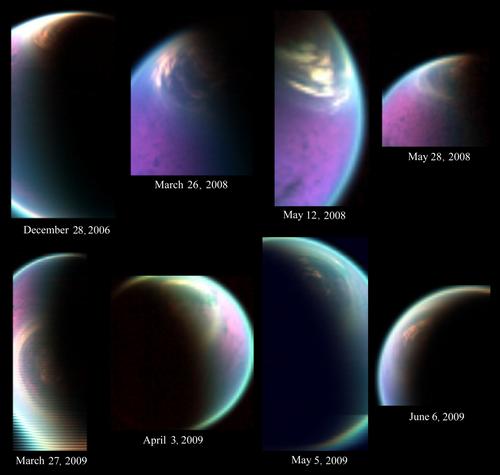
The mosaic of false-color images above based on VIMS data from 2006 to 2009 reveals the evolution of the cloud system in the north polar region of Saturn's largest moon Titan. The cloud systems appeared to be thinner or to dissipate in the transition period between the Winter season in the northern hemisphere and the the Spring season in the northern hemisphere. The Spring Equinox occured in August 2009. Image credit: NASA/JPL-Caltech/University of Arizona/CNRS/LPGNantes
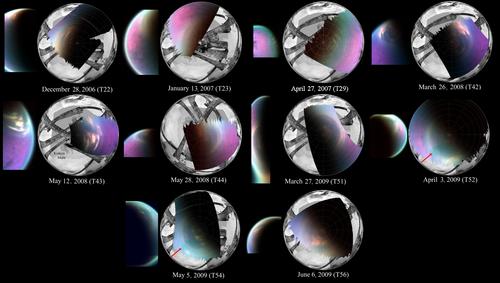
The mosaic above unveils pairs of images of the cloud system in the north polar region of the Orange Moon, obtained from 2006 to 2009 with the VIMS of the Cassini probe. One can notice that the clouds seem to dissipate over time as the Spring season in the northern hemisphere approaches. Image credit: NASA/JPL-Caltech/University of Arizona/CNRS/LPGNantes/SSI
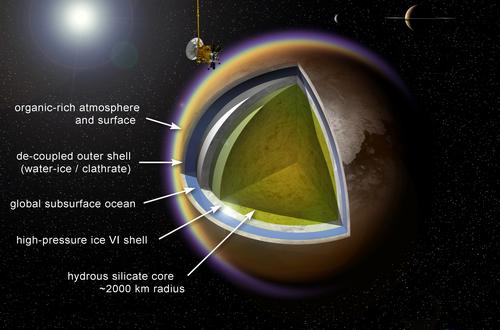
The artistic view above describes the internal structure of the Orange Moon on the basis of data obtained from the Cassini spacecraft (Radar data, VIMS data, magnetometer data...) and on the basis of the work of Dominic Fortes who developed a series of models to account for the internal structure of Titan. The core may be composed of hydrous silicate and an internal ocean of liquid water may exist between the crust and the high-pressure ice beneath it. Image credit: A.D. Fortes/UCL/STFC.
|
|
|
|
| The artistic view in the upper part of the table, based
on radar data taken by the Radar Mapper of the Cassini spacecraft,
reveals a cloudy and hazy weather in the area of Ligeia Mare. The radar
portion in the lower part of the table, acquired on April 10, 2007, shows the area represented in the
artistic view. The arrow was incorporated into the radar portion by Marc
Lafferre to indicate the orientation of the virtual camera.
© Artistic image:
Marc Lafferre, 2012 |
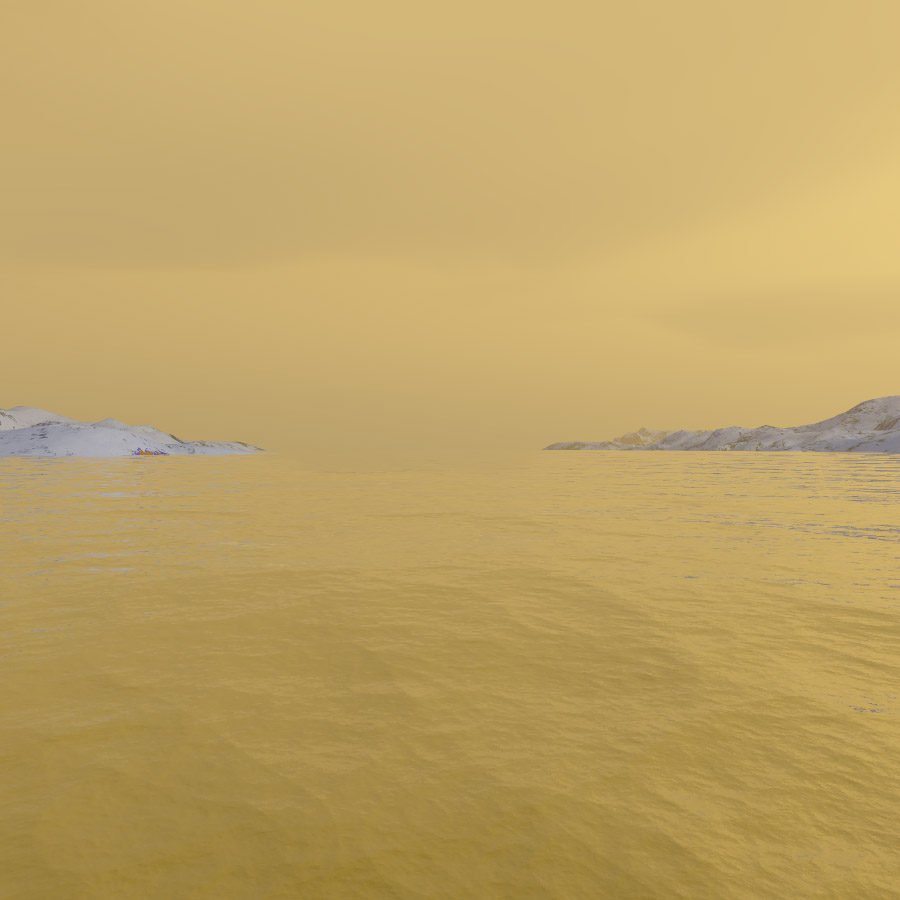
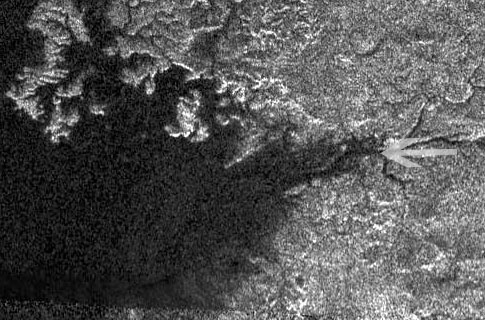
- To get further information on that news, go to: http://saturn.jpl.nasa.gov/news/cassinifeatures/feature20120223.
February 2, 2012: The Size of Titan's Dunes is Intimately Related to Latitude and Altitude Parameters
Since the arrival of the Cassini/Huygens spacecraft in the Saturn System in 2004, the Radar Mapper and the Visual and Infrared Mapping Spectrometer of the Cassini probe have allowed planetary scientists to discern and analyze landscape features on the surface of the "Opaque Moon" Titan.
A contrast between bright and dark areas has been well identified by planetologists on the basis of near-infrared images obtained with the VIMS instrument of the Cassini spacecraft.
It appears that the dark areas are concentrated in the low latitudes of the Orange Moon. The bright areas dominate the high latitudes. Icy materials such as water ice or frozen carbon dioxide may be widespread in the bright areas. As on Earth, mountain chains can be found in the bright regions such as the Continent-sized Xanadu which can undergo tectonic movements or quakes.
Bright areas are less abundant in the low latitudes. The bright Adiri of the equatorial and tropical region was imaged from the Huygens probe during its atmospheric descent into the Shangri-La/Adiri region on January 14, 2005. It revealed topographic fractures or drainage channels which seemed dried up suggesting occasional rainfall.
The Huygens probe apparently landed close to the bright Adiri in a dried-up river in the Shangri-La region. The soil and the sky appeared orange and eroded stones or pebbles appeared in the foreground.
The radar instrument of the Cassini spacecraft has allowed scientists to gather crucial information on the dominant topographic structures of the dark areas and on meteorological phenomena such as the direction of prevailing winds.
The radar images clearly reveal the famous "Cat Scratches" which correspond to Seif Dunes or linear and parallel dunes extending over long distances. Those dune fields are found in the dark areas of the low latitudes. Thus, the dark Shangri-La, the dark Fensal/Aztlan or the dark Belet are dominated by Seif Dunes or parallel and linear dunes shaped by prevailing winds.
A new study led by Alice Le Gall, of LATMOS-UVSQ, Paris and NASA-JPL, California reveals that the size of the dunes and the structure of the dune fields are related to altitude and latitude factors.
An image comparison was performed between dunes in the Belet region, dunes in the Fensal region, dunes in Oman on Earth and the Kalahari dunes. The size and spacing of the dunes in the Belet region appear different from the size and spacing of the dunes in the Fensal area. The Fensal area is made of narrower dunes, lower altitude dunes with a higher spacing between the dunes. The gaps between the dunes are brighter in the Fensal area implying a thinner covering of sand.
The Fensal region is higher in altitude and in latitude than the Belet area. One can infer, from the radar data, that the amount of sand grains is lower at higher latitudes and higher altitudes and that the dunes tend to become narrower, lower and more widely separated at higher latitudes and altitudes, because there is a lower amount of sediments available in those regions.
The size, the shape and the direction of the dunes provide us with significant clues on the geology of the area and on the climate and meteorology of the region. One can observe in the radar views that prevailing winds have a strong power and that they shape the topography, generating linear and parallel dunes which can be deflected by bright topographic obstacles made of a different material.
Scientists have determined that dune fields represent approximately 13% of the surface of Saturn's largest moon, stretching over an area of 10 million square kilometers or 4 million square miles. That corresponds to about the equivalent of the surface area of the United-States, Canada or China.
The Titanian dunes which resemble the Terrestrial dunes found in Namibia (Namib Desert) or in the Arabian Peninsula are on average 1 to 2 kilometers wide or 0.6 to 1.2 miles wide, hundreds of kilometers or miles long and approximately 100 meters or 300 feet high, their size and spacing varying as a function of the altitude and the latitude.
The chemical composition of the Titanian sand appears exotic. On Earth, the dunes are dominated by silicates (SiO2...) but on Titan, the dunes may be dominated by solid hydrocarbons that precipitate out of the atmosphere. They may incorporate the famous tholins imagined by the astronomer Carl Sagan. The exact nature of the hydrocarbons is unknown but the dunes may be made of molecules such as acetylene and benzene. The hydrocarbons from the atmosphere may have aggregated into millimetre-sized grains or grains 0.04 inch in size.
The dunes appear to be confined to its equatorial area, in a band between 30 degrees south and 30 degrees north. The higher latitudes appear to be less dry or to have a higher level of moisture. The VIMS instrument of the Cassini probe has revealed, via near-infrared images, that the high latitudes of the southern hemisphere can reveal dynamic cloud formations which are likely to engender methane/ethane rain and that the high latitudes of the southern hemisphere can harbor lakes or seas. The dark "Ontario Lacus" was the first body of liquids clearly identified on Titan. Ontario Lacus is located in the high latitudes of the southern hemisphere.
Likewise, the high latitudes of the northern hemisphere host a myriad of lakes, seas and rivers. The pools of liquids appear to be mostly concentrated in the high latitudes or in the polar region of Titan's northern hemisphere. The dark Kraken Mare is so big that it can be regarded as a sea. Ligeia Mare and Punga Mare are also well known lakes or seas found in the high latitudes of the northern hemisphere.
No dune fields have been identified in the polar areas of Titan. The soil may be too wet in those areas due to relatively frequent storms or rainfall events which fuel the lakes, seas and rivers of methane or ethane. As a result, the sand particles will be heavier and less mobile. The drier the sand grains, the more easily they can be displaced or transported by the winds to generate dunes.
Doctor Alice Le Gall advanced: "As one goes to the north, the soil moisture probably increases, making the sand particles less mobile and, as a consequence, the development of dunes more difficult."
Nicolas Altobelli, ESA's Cassini-Huygens project scientist pointed out: "Understanding how the dunes form as well as explaining their shape, size and distribution on Titan's surface is of great importance to understanding Titan's climate and geology."
The formation of clouds in the low latitudes of the Orange Moon appears particularly rare on the basis of the near-infrared images taken with the VIMS instrument of the Cassini spacecraft. However, unusual, large cloud systems were identified in 2010 a little after the equinox which occured in August 2009. The variations in the amount of solar energy reaching the soil, related to seasonal changes and orbital distances may have a strong impact on the meteorology of the equatorial or tropical regions.
The low-latitude regions may have recently received precipitations or rainfall of hydrocarbons (methane or ethane). Alternating periods of precipitation and dryness implying evaporation and erosional processes may have favoured the development of sand dunes in the dark areas of the low latitudes over time.
The climate and meteorology of Titan are relatively complex because the obliquity of the moon is relatively high with a tilt of the rotation axis of about 27 degrees relative to the normal of the orbital plane around the Sun. Moreover, the orbit of the Saturn System around the Sun is elliptical with an aphelion which is 12% farther from the Sun than the perihelion which implies that the potential amount of energy reaching the soil can be 20% weaker at aphelion than at perihelion.
The Titanian year is roughly 29.5 years long with seasons that last for about 7 Earth years. The Summers in the southern hemisphere are shorter and more intense than Summers in the northern hemisphere due to the fact that the Orange Moon moves closer and faster to the Sun during the Summer period in the southern hemisphere. That may explain the asymmetry in the distribution of lakes and seas between the north polar region and the south polar region.
As the Winter period approaches in the southern hemisphere, there may be more and more precipitation in the high latitudes of the south polar region in the coming years which may engender new lakes, seas and rivers.
Further analyses are needed to correctly determine the methane/ethane cycle in the low latitudes of the Opaque Moon. Will there be monsoon events or storms in the area? Will the Seif dunes of the low latitudes disappear under the action of strong methane or ethane precipitation?
The Cassini spacecraft has examined the geology, the climate and the meteorology of the moon for about seven Earth years which is only the equivalent of a Titanian season. But scientists are now in a position to improve their climate models and to make predictions.
Several parallels or similarities can be established between the geological features on Earth and on Titan and between the methane/ethane cycle and the water cycle on Earth. As on Earth, there are precipitation and evaporation processes, mountains, rivers, lakes and seas and the dune fields are reminiscent of dune fields in the Namib Desert.
Nicolas Altobelli explained: "As their material is made out of frozen atmospheric hydrocarbons, the dunes might provide us with important clues on the still puzzling methane/ethane cycle on Titan, comparable in many aspects with the water cycle on Earth."
The dunes of hydrocarbons of the "Paradise of Hydrocarbons" may have undoubtedly represented a gold mine for our oil companies if it had taken shape on our Blue Planet because the resources seem almost illimited up there.
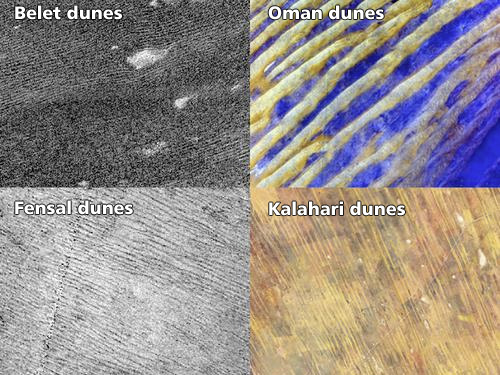
The mosaic above shows some similarities between dune fields on Earth and on Titan. One can notice that the dunes in the Fensal area appear narrower and less high than the dunes in the Belet area which is found at a lower latitude and where there is a higher amount of sand. The Oman dunes and the Kalahari dunes also reveal linear and parallel structures or Seif dunes. Image source: NASA/JPL-Caltech, and NASA/GSFC/METI/ERSDAC/JAROS and U.S./Japan ASTER Science Team
|
|
|
|
| The mosaic in the upper part of the table shows radar views of parallel and linear dunes or Seif dunes in the Belet area and in the Fensal area. The dunes in Fensal seem narrower and lower than the dunes in Belet with a wider space between the dunes. The mosaic in the lower part of the table reveals linear and parallel dunes in the Namib Desert in Namibia and in the desert of the Arabian Peninsula between Saudi Arabia and Yemen. The topography of Seif Dunes on Earth is reminiscent of the parallel and linear dunes in the dark areas of the low latitudes of Saturn's largest moon. Image source of the upper mosaic: NASA/JPL. Image Source of the lower mosaic: Google Earth. PS: A scale was added into each radar view by Marc Lafferre. |
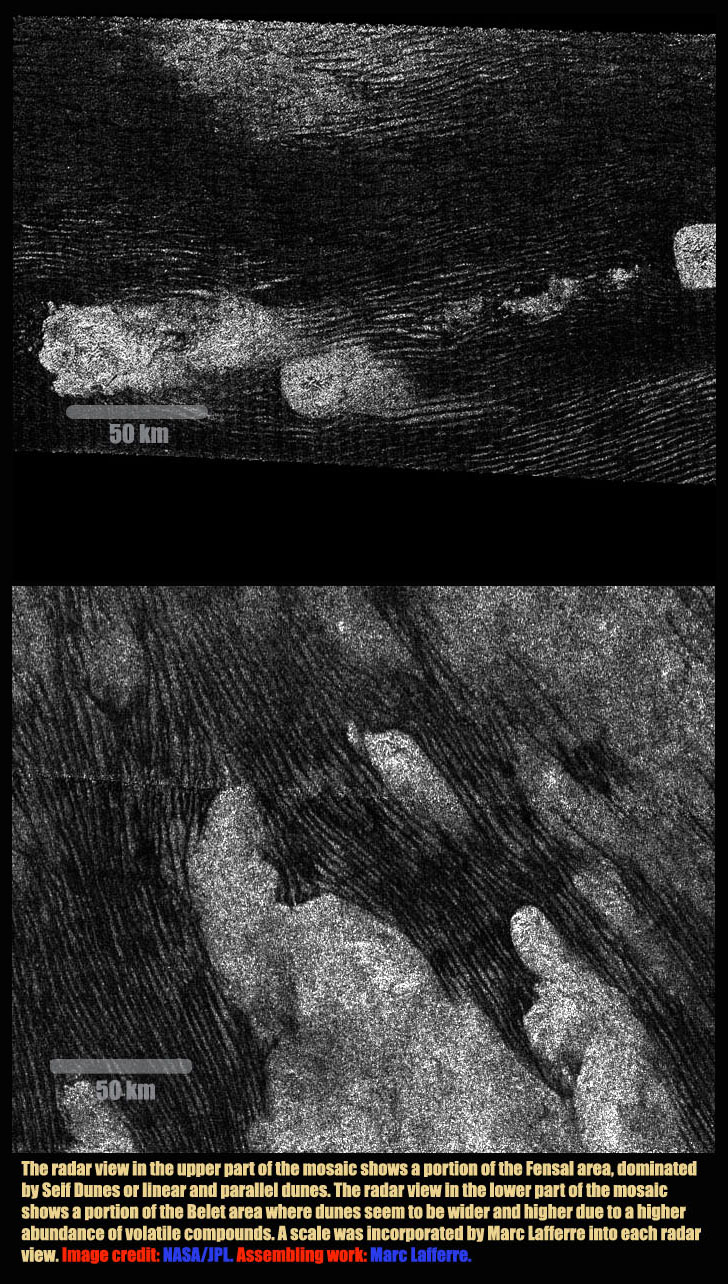
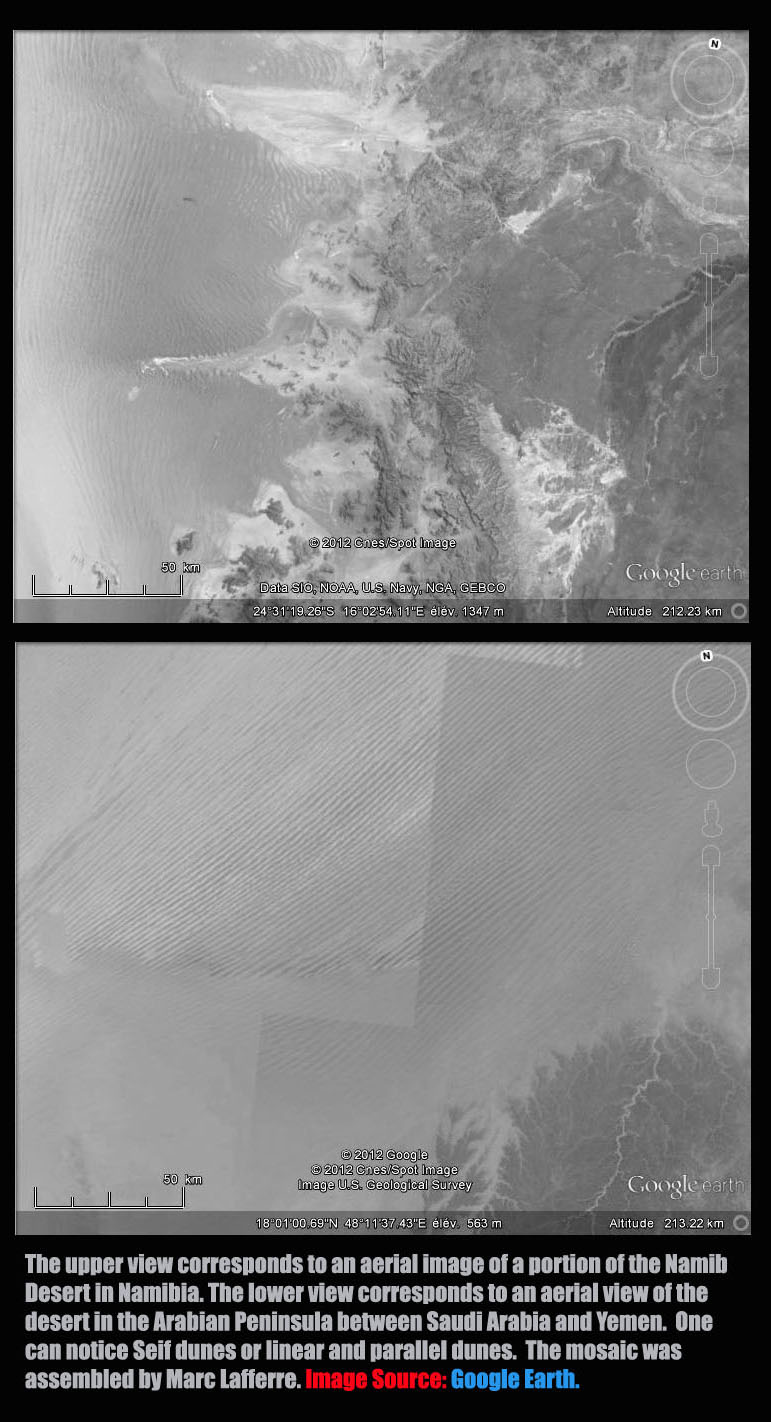
- To get further information on that news, go to: http://www.esa.int/esaCP/SEMX5NH8RXG_index_0.html and http://astrobio.net/pressrelease/4504/titans-giant-dunes.
January 21, 2012: Meteorological Phenomena on Titan Explained by a New Three-Dimensional Atmospheric Model which Brings Predictions
The "Orange Moon" Titan is an exotic world which presents striking similarities with our "Blue Planet". Like the Earth, Titan is covered with a significant atmosphere comprising dynamic clouds. However, Titan orbits farther than the Earth from the Sun receiving less solar energy than the Earth. The Huygens probe which landed in the Shangri-La/Adiri region on January 14, 2005 recorded a surface temperature of approximately -179 degrees Celsius, -290 degrees Fahrenheit or 94 Kelvin.
The atmospheric pressure on the surface of Saturn's largest moon is largely higher than that on the surface of the Earth at sea level. The Huygens probe recorded an atmospheric pressure of 1467 hPa or mb on the ground of the Opaque Moon on January 14, 2005.
The composition of Titan's atmosphere is different from that of the Earth: Molecular nitrogen is the most abundant molecule in the atmosphere of the Earth and Titan. It represents approximately 78% of the composition of the atmosphere of the Earth and about 94% of the composition of the atmosphere of Titan.
Contrary to the atmosphere of the Earth, that is made of 21% oxygen, the atmosphere of Titan is devoid of any significant amount of oxygen. The second most abundant molecule in the atmosphere of the Orange Moon is methane which can represent up to 5% of the composition of the atmosphere.
The meteorology of Titan is intimately linked to methane which is involved in a methane cycle comparable to the water cycle of the Terrestrial meteorology.
The air above the soil of Titan is largely denser than the air of the Earth at seas level. Moreover, due to the relatively weak density of the Titanian sphere and the smaller size of Titan which is about 5150 km or 3200 miles in diameter, the gravity on the surface of Titan is about seven times weaker than the gravity on the surface of the Earth.
Like the Earth, the landscape of Titan is made of lakes, seas, rivers and the atmosphere of Titan incorporates clouds of methane and ethane which can generate methane or ethane rain as well as snow. Thus, there are processes of evaporation and precipitation on Titan like in the atmosphere of the Earth.
But the dynamics of cloud formation appears different on Titan due to seasons and orbital distances. Like on Earth, the seasons are well marked due to the relatively high obliquity of Titan whose rotation axis is tilted by about 27 degrees to the normal of the orbital plane compared to 23.4 degrees for the obliquity of the Earth.
Planetary scientists are trying to reproduce the dynamics of the meteorology of Titan on the basis of the physical and meteorological characteristics of the opaque, thick and deep atmosphere of the Orange Moon. What are the key meteorological observations which must be reproduced by computer models of atmospheric circulation?
Since the arrival of the Cassini spacecraft in the Saturn system in 2004, a high concentration of bright clouds has been observed in the high latitudes of the southern hemisphere during its summer period. Dynamic cloud systems have been noticed in the area of the radar-dark Ontario Lacus, the first body of liquid identified in the south polar region of the moon.
A large ethane cloud system, reminiscent of a giant cyclone or hurricane was observed in 2006 above the north polar region with the VIMS instrument of the Cassini probe. The observation was performed during the winter period in the northern hemisphere.
Radar images obtained from the Cassini probe have also shown a pleiade of bodies of liquids in the high latitudes of the northern hemisphere during the Winter period. Kraken Mare, Ligeia Mare and Punga Mare are the most famous lakes or seas in the north polar region. A relationship has been made between cloud formation and the presence of seas, lakes and rivers.
Paradoxically, the equatorial and tropical region where the Huygens probe landed on January 14, 2005 appears particularly dry, dominated by dark Seif Dunes or parallel dune fields extending over long distances. No lakes or seas have been identified in the low latitudes of Titan and a few sporadic cloud systems have been observed at mid-latitudes.
Yet, an unusual concentration of bright cloud systems was recently observed in the low latitudes of Titan during the transition between the Winter period in the northern hemisphere and the Spring season in the northern hemisphere. The vernal equinox occured in August 2009 which marked the beginning of the Autumn season in the southern hemisphere and the Spring season in the northern hemisphere. Each season lasts approximately 7 Earth years and a Titanian year lasts about 29.5 years.
The higher amount of energy reaching the soil in the low latitudes during the period of the equinox may have engendered a higher amount of evaporation and massive cloud systems bringing precipitations in the areas of the dark Belet, Senkyo, the bright Adiri, the dark Shangri-La or the dark Fensal/Aztlan.
Previous atmospheric models failed to explain all those meteorological phenomena. Endogenic processes such as cryovolcanoes spewing methane or ethane have been incorporated into the atmospheric or meteorological models to account for the observations.
A new computer model accounts for all the observations of the Titanian atmosphere. The model is a Three-dimensional atmospheric model based on the fundamental principles of atmospheric circulation. The model takes into account a dynamic surface reservoir of methane. The model is presented by Tapio Schneider, Sonja Graves, Emily Schaller and Mike Brown in the January 5 issue of the journal Nature in a paper entitled "Polar methane accumulation and rainstorms on Titan from simulations of the methane cycle."
Tapio Schneider, the Frank J. Gilloon Professor of Environmental Science and Engineering advanced: "We have a unified explanation for many of the observed features."..."It doesn't require cryovolcanoes or anything esoteric."
The simulation reproduces quite well the atmospheric observations and it generates the distribution of lakes. Why are the lakes and seas concentrated in the polar regions? It appears that the amount of solar energy reaching the polar regions is lower than the amount of solar energy reaching the low latitudes. Therefore, methane will condense and accumulate more easily in the polar regions, forming lakes, seas and rivers.
Why is there an imbalance between the distribution of liquid bodies in the south polar region and the north polar region? The higher concentration of liquid bodies in the north polar region may be closely related to the elongated orbit of Saturn and Titan around the Sun. The Summer period appears to be the rainy period and the Orange Moon is farther from the Sun when it is Summer in the northern hemisphere. As a result, on the basis of Kepler's second law, the Summer period in the northern hemisphere is longer than the southern Summer because the moon orbits more slowly at aphelion than at perihelion.
Yet, the south polar region receives a more intense amount of solar energy during the Summer period because it moves closer to the Sun. A significant process of evaporation and precipitation may take shape in the area. Since the Winter season is approaching in the southern hemisphere, the lakes and seas of the south polar region may lose a portion of their volume in the coming years. The opposite may occur in the north polar region with net precipitation of methane and ethane as the Summer season of the northern hemisphere approaches.
The net precipitation in polar regions may be accompanied by slow along-surface methane transport towards mid-latitudes and subsequent evaporation processes. Rare and intense storms take shape around the equinoxes, generating enough precipitation to engender drainage channels or rivers. The clouds which bring methane rain are found in the Troposphere and they form primarily in middle and high latitudes of the Summer hemisphere. Tapio Schneider pointed out: "It rains very rarely at low latitudes."..."But when it rains, it pours."
The three-dimensional model of atmospheric circulation simulates the atmosphere of the Orange Moon for 135 Titan years or 3,000 Terrestrial years which is enough to reach a steady state. At aphelion, Titan evolves about 12% farther from the Sun than at perihelion, since it orbits at a distance of approximately 1,513,325,783 km compared to about 1,353,572,956 km at perihelion.
Marc Lafferre, a specialist of Titan calculates that the amount of energy received by Titan from the Sun at aphelion is about 20% weaker than at perihelion. At aphelion, the energy received is 13.50 Watt/m² compared to 16.88 Watt/m² at perihelion. As a result, the potential temperature, at aphelion, is -185.31 degrees Celsius compared to -180.27 degrees Celsius at perihelion which results in a potential surface temperature difference of 5.04 degrees Celsius between aphelion and perihelion.
It appears that the meteorology of Titan is influenced by the variation in the orbital distance as well as by the inclination of the rotation axis. The sporadic cloud systems identified in the low latitudes of Titan in 2009 by Emily Schaller, Mike Brown, Tapio Schneider and Henry Roe demonstrate that the low latitudes of Titan can encounter monsoon events or strong rainfall periodically. That may explain the presence of drainage channels in the bright Adiri as the images taken from the Huygens probe had revealed during its descent throughout the atmosphere of Titan.
Tapio Schneider, the Frank J. Gilloon Professor of Environmental Science and Engineering, Sonja Graves, a Caltech graduate student, Emily Schaller, a former Caltech graduate student and Mike Brown, the Richard and Barbara Rosenberg Professor and professor of planetary astronomy predict, on the basis of the simulations, that the lake levels in the north polar region will rise over the next fifteen years due to the changing seasons and that prominent clouds will form in the north polar region in the next two Terrestrial years. Tapio Schneider concluded: "In a few years, we'll know how right or wrong they are."
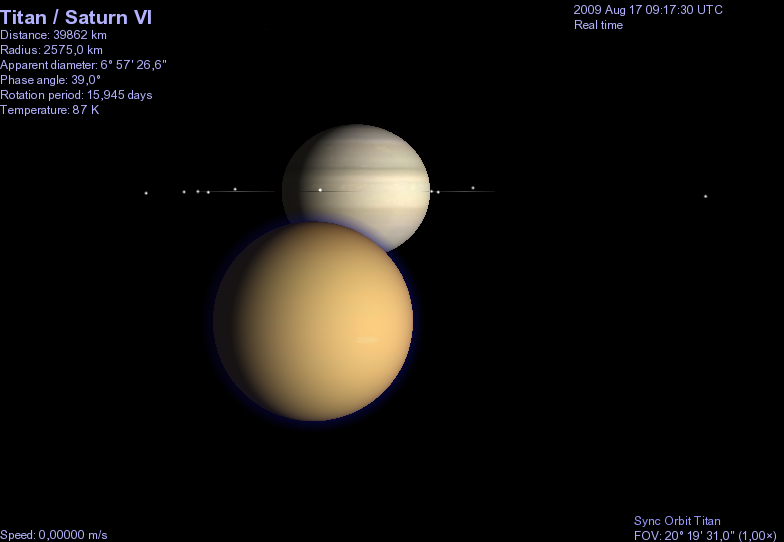
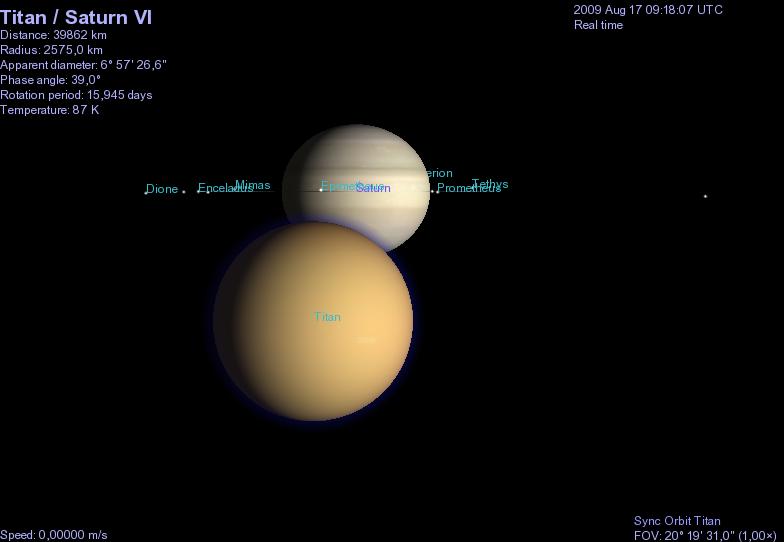
The simulated views above, generated with the software Celestia, show the Orange Moon Titan in the foreground in the period of the Equinox on August 17, 2009. The texture of Titan, in this view, was produced by Marc Lafferre. One can notice a bright cloud formation in the low latitudes of Saturn's largest moon. Saturn and some of its moons such as Dione, Tethys and Enceladus can be identified in the background on the same plane as the equator of Saturn and the rings of Saturn, roughly speaking. The low latitude areas such as Shangri-La, Adiri or Fensal/Aztlan are thought to receive high amounts of rain of hydrocarbons (ethane, methane...) around the Equinox due to a higher amount of solar energy reaching the soil of the low latitudes in this period.
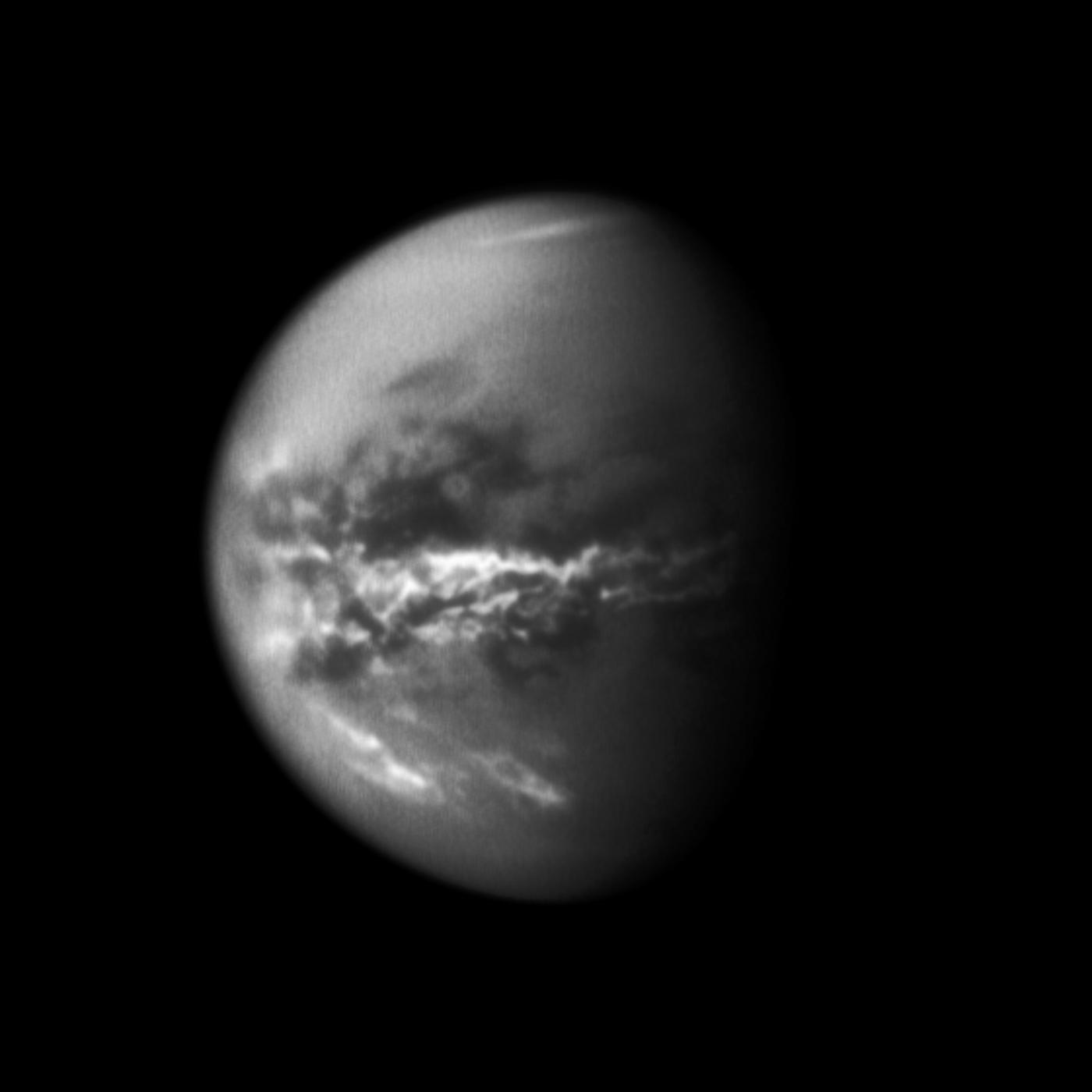
The image above corresponds to a near-infrared view of the disc of Titan revealing an unusual concentration of cloud systems at low latitudes on October 18, 2010. The climate model of the Opaque Moon predicts rainfall at low latitudes around the Equinox. The Equinox occured in August 2009. Large cloud formations can be identified over the Fensal/Aztlan region, here. Image credit: NASA/JPL/Space Science Institute
- To get further information on that news, go to: http://media.caltech.edu/press_releases/13484 and http://www.nature.com/nature/journal/v481/n7379/full/nature10666.html.
Titan
News 2011
Titan
News 2010
Titan
News 2009
Titan News 2008
Titan
News 2007
Titan
News 2006
Titan News
2004, 2005