July 1st 2026: A Summit To Prepare The Ground For Human Expeditions On Titan !
The Cassini-Huygens mission has clearly shown that Titan, the largest moon of Saturn, is a fascinating and intriguing world that looks like the Earth to a certain extent. We have identified several worlds in the Solar System that represent key destinations regarding the study of organics, the study of hydrocarbons or the study of prebiotic chemistry. Planetologists or astrobiologists have focused their attention on the environment of Mars and Venus in particular. Mars contains water ice in its high latitudes or in its polar areas and there may have been pools dominated by liquid water as well as active rivers in the past. Our probes or rovers like Opportunity, Spirit, Curiosity and Perseverance have gathered a huge amount of data regarding the geology or the chemistry of Mars and we might have found signs of ancient life in the dry environment where ancient rivers may have been present. We could send humans to the surface of Mars and we could create colonies on that world where the air is extremely thin and where the air is dominated by carbon dioxide. However, the mean environmental temperature is extremely low on Mars. The astronauts would need special suits in order to breathe with a correct pressure.
Any human expedition on Mars could take place in the high latitudes or in the polar regions where water ice is widespread. That water ice could be mobilized by any colony developing on the Red Planet. Tunnels and underground habitats could be created. The astronauts could live underground so that they would be permanently protected from the harmful radiations of the Sun that reach the soil. On Venus, the exploration missions are much more difficult to perform because the environmental temperature and the atmospheric pressure on the surface are extreme. The environmental temperature at the level of the surface on Venus is around 467 degrees Celsius and the atmospheric pressure on the surface is also extreme with a level of 93 bar. The Venera 13 probe and the Venera 14 probe sent by the USSR had not survived a long time once on the surface of that world ! Obviously, we can't envisage human expeditions to the surface of Venus. However, in the thick atmosphere of that opaque planet, one can envisage airships or balloons that could explore the environment and gather samples in order to identify the chemistry of the air.
Astrobiologists have envisaged that the atmosphere of Venus could contain microorganisms, bacteria or archaea. The atmosphere is quite strange with its clouds dominated by sulfuric acid. Any team of astronauts sent to the atmosphere of Venus will have to gather new clues regarding the chemistry, the dynamics and the history of the atmosphere. Why is Venus so different from the Earth ? Where is water on Venus ? Is there life in the atmosphere of Venus ? The exploration of the Outer Solar System has also revealed captivating worlds that deserve a particular attention. Jupiter, for instance, has remarkable moons. Io is clearly the most active world of the Solar System in terms of volcanism or geology. Europa is composed of fractures that may be related to a subsurface ocean rich in liquid water. We could send a probe to the surface of Europa but could we send a team of astronauts to that world ? Europa is devoid of any significant atmosphere so that any astronaut would have to be correctly protected from any harmful radiation from the Sun. The astronaut would also have to cope with the level of radioactivity related to the magnetosphere of the Gas Giant Jupiter.
Researchers have also identified key destinations beyond Jupiter. In the system of Saturn, there are moons that are particularly rich in water ice. That's the case for the tiny moon Enceladus where fractures related to cryovolcanic events or geysers have been clearly identified from the Cassini orbiter during its long mission in the Saturn System. Enceladus may also have an internal ocean dominated by liquid water. Therefore, Enceladus represents a key destination for the study of organics, prebiotic chemistry or even microorganisms. Any module, probe, vehicle or rocket would have to find a relatively flat place on that moon in order to safely land. There is no atmosphere on Enceladus so that the landing phase could not depend on parachutes like on Mars or Titan. The landing vehicle would have to mobilize the thrusters in order to land in the right way. Leaving that world would not be a major problem at first sight because the gravity of Enceladus is extremely low compared to the gravity of the Moon or Titan for instance. The most fascinating moon in the Saturn System appears to be Titan due to its deep and opaque atmosphere in particular.
The atmosphere of Titan is dominated by molecular nitrogen like our own atmosphere. However, oxygen is absent or almost absent in the exotic atmosphere of Saturn's largest moon. The atmosphere of Titan contains a relatively significant concentration of methane. Methane is a simple hydrocarbon that represents what we call the natural gas on Earth. Methane whose chemical formula is CH4 is composed of one carbon atom and of 4 hydrogen atoms. In the harsh environment of the giant moon of Saturn, methane can be present in its liquid form on the surface, can evaporate, can condense, can form clouds and can engender precipitation events like on Earth. A parallel between the meteorology of the Earth and the meteorology of Titan can be drawn. The images of the surface acquired during the Cassini-Huygens mission in the Saturn System have clearly revealed a varied landscape where stable pools, lakes, seas and rivers can be found. The radar images obtained from the Cassini orbiter have clearly revealed that the humid areas on Titan are found in the high latitudes or in the polar regions. Can an exotic lifeform develop in those pools or rivers ?
There is clearly an astrobiological dimension in the study of Titan. That's why there are ambitious projects or missions to study the environment of that world. One can mention the Dragonfly mission that will mobilize a rotorcraft fueled by nuclear energy in the environment of Titan in the 2030s. Thanks to the progress in propulsion technologies in particular, one can envisage human missions to the surface of Titan in the far future. A summit devoted to that possibility was organized on June 11 and on June 12, 2026 at the Southwest Research Institute (SwRI) facility in Boulder, Colorado. Researchers or specialists like Amanda Hendrix, Ralph Lorenz and Bill O'Hara intervened to talk about the challenges of human missions to Saturn's largest moon. Several key subjects were addressed. One can mention the subject of the spacesuit and the subject of the air systems. The subject of power generation was also addressed. Any mission to the system of Saturn or to the system of Titan implies nuclear energy because we can't rely on solar panels at that huge distance from the Sun. That was the case for the Cassini-Huygens spacecraft. That will also be the case for the Dragonfly rotorcraft that will evolve in an environment where the ambient temperature evolves around -179 degrees Celsius, -290 degrees Fahrenheit or 94 Kelvin.
Any human mission to the surface or to the atmosphere of Titan will likely take a huge amount of time. The current technology allows us to send orbiters to the Saturn System in about 6 or 7 years. For instance, the Cassini-Huygens mission took about 7 years to reach the system of the Ringed Planet Saturn from the launch in 1997 with a Titan IV rocket to the arrival in the Saturn System in 2004. Any human mission to Titan implies a significant payload so that the rocket must be extremely powerful. The astronauts must have the required amount of air, the required amount of food as well as the required amount of water. Landing on the surface of Titan is not a very difficult task at first sight since the air is particularly dense so that parachutes should do a good job to slow down the craft. We will probably have to mobilize an orbiter around Titan like in the Apollo program in which a spacecraft was in orbit around the moon. Once the mission is over on the surface of Titan, the astronauts will likely mobilize a rocket to leave Titan and their module or rocket will have to reconnect to the orbiter in order to go back to the Blue Planet.
If it takes 7 years to go back to Earth, the travel time will be very long ! Can we imagine a travel time of at least 14 years ? The astronauts will have to do a lot of sport in the absence of a significant gravity. If the propulsion technology improves, one can imagine a shorter travel time but, in any case, it will be a very long trip and it won't be cost effective economically speaking. In the future, one can imagine propulsion technologies in the form of nuclear thermal propulsion (NTP) or in the form of nuclear electric propulsion (NEP). With ion thrusters, one can imagine a high Delta-V over time in outer space but once you arrive in the Saturn System you must slow down in order to get the orbital trajectory around Saturn or to get the orbital trajectory around Titan. One can imagine several modules as well as several rockets for a human expedition to Titan. The astronauts will have to be relatively autonomous because any signal sent from Earth to the team of astronauts takes more than one hour. The message of the astronauts to the engineers or researchers on Earth will also take more than one hour. Therefore, any technical problem would be hard to manage on Titan. A network of orbital stations or bases from the Earth to the system of Saturn will be probably needed for any human exploration of that intriguing world in the far future.
|
|
|
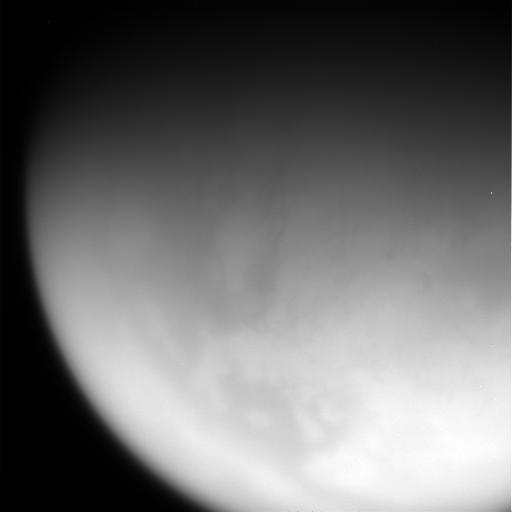
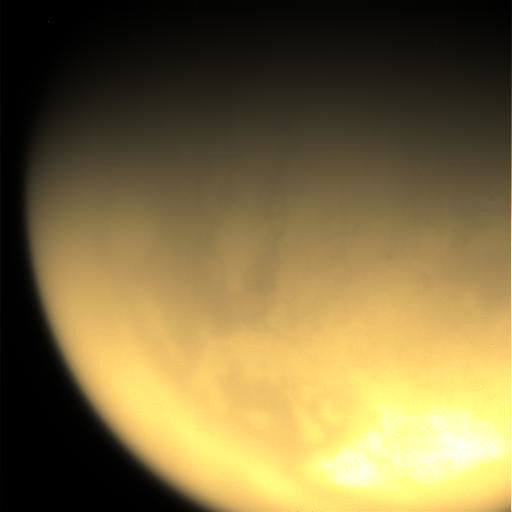
The image in the upper part of the table represents a raw view of a portion of Titan acquired with the eye of the Cassini orbiter on December 28, 2006. The view whose file name is W00021162.jpg was obtained on the basis of the CB3 filter and on the basis of the CL2 filter. The image had not been validated or calibrated at the time of the observation and a validated or calibrated version of the original view had to be archived with the Planetary Data System proposed by NASA. The image in the lower part of the table represents a colorized version of the original view. Credit for the original image: NASA/JPL-Caltech/Space Science Institute. Credit for the colorization process of the original image: Marc Lafferre, 2026. |
- To get further information on that news, go to: https://exploretitan.org/humans-to-titan-summit-1 and https://spacenews.com/mars-to-titan-the-next-rallying-call/ .