July 7, 2026: JWST Spectroscopy Reveals The Presence Of A Mysterious Substance On The Surface Of Titan And On The Surface Of Pluto
A new study entitled "An unidentified absorption feature at 5.11 µm on the surface of Titan and Pluto from JWST spectroscopy", published in arXiv on June 11, 2026 and proposed by a team of researchers involving Bruno Bézard reveals the presence of an intriguing substance on the surface of Titan and on the surface of Pluto thanks to spectroscopic data acquired from the James Webb Space Telescope (JWST). Titan and Pluto represent two worlds of the Outer Solar System that unveil remarkable similarities at first sight. Titan is the largest moon of Saturn whereas Pluto is a dwarf planet evolving much farther from the Sun than Titan. Both worlds contain an atmosphere but the atmosphere of Pluto is extremely thin compared to the relatively massive atmosphere of Titan. Yet, both atmospheres look alike to a certain extent. The atmosphere of Titan is dominated by molecular nitrogen which is also the case for the atmosphere of the Earth and for the atmosphere of Pluto. The atmosphere of Titan is remarkably rich in methane, in the low altitudes in particular where the concentration of the molecule can be as high as 5 percent of the environmental composition.
The thin atmosphere of Pluto also contains methane. Planetologists are particularly interested in the chemistry of hydrocarbons and organics on the icy worlds of the Outer Solar System. Pluto and Titan are part of those worlds that draw the whole attention of planetologists and astrobiologists. The atmosphere of Titan can engender complex hydrocarbons or organics and that may also be the case for Pluto even if the environmental temperature is extremely low. Heavier molecules will tend to fall to the surface. The Huygens probe had unveiled a dark or orange soil on the landing site. Researchers are particularly interested in that type of environment where water ice or carbon dioxide can only appear in their solid form. The dark or orange soil of Titan and Pluto may clearly present some similarities in terms of composition. However, the study of the surface of Titan from outer space is difficult due to the presence of a thick and opaque atmosphere in the visible spectrum. We have obtained a huge amount of data regarding the surface of Titan thanks to the Cassini spacecraft in particular. We also have a significant amount of data regarding the surface of Pluto thanks to the New Horizons probe in particular. Now, we can rely on data acquired from the JWST and new mysteries appear !
The best way to study a world of the Solar System is to send a probe to the surface of that world. We have reached the surface of the Moon, the surface of Venus, the surface of Mars as well as the surface of Titan but we have never reached the surface of Pluto. The New Horizons probe had allowed us to observe and to analyze the surface of Pluto thanks to a very quick flyby performed on July 14, 2015. The study of Titan and Pluto continues thanks to new data acquired from the James Webb Space Telescope in particular. The team of Bruno Bézard has been in a position to identify the presence of a mysterious substance, probably present on the surface, on Titan and Pluto thanks to spectroscopic data obtained with the JWST. The unidentified absorption feature was detected at 5.11 µm on the surface of both worlds. The researchers took advantage of the high sensitivity and of the large spectral coverage of the James Webb Space Telescope to look for new features of the atmosphere and of the surface of Titan and Pluto in the 5-µm atmospheric window. They selected JWST NIRSpec and MIRI spectra around the disk center of the giant moon of Saturn and they compared the NIRSpec average spectrum with a radiative transfer model incorporating gas and haze opacity.
The outcome of the study of the team revealed the detection of an unidentified absorption in both NIRSpec and MIRI spectra of the Opaque Moon centered at 5.113 µm (1956 cm-1) and 6-7% deep. The width of the unidentified absorption is 0.024 +- 0.0008 µm (9.2 +- 0.3 cm-1) in the NIRSpec spectrum acquired and related to the trailing side and is probably 25% narrower in the MIRI spectrum of the leading side. The planetologists believe that the absorption is related to a substance found on the surface of Titan rather than in its atmosphere. The nature of the substance or molecule is unknown ! The team was not in a position to identify the spectral signature on the basis of published laboratory spectra of ices related to the atmospheric compounds of the giant moon. However, the researchers think about a few potential candidates. The study also reveals that a 4-5% deep absorption is present in the MIRI spectrum of the dwarf planet Pluto but that absorption is approximately 3 times broader than on the trailing side of Titan. Even if the environment of Pluto is much more colder than the environment of Titan, the chemistry on the surface may be relatively close on both worlds.
Titan and Pluto represent two major worlds of the Outer Solar System that contain a relatively varied chemistry mobilizing elements or molecules like carbon, molecular nitrogen, methane and ethane. Titan and Pluto are not uniform moons dominated by craters. Their landscape is relatively active and varied. There are bright areas on both worlds and there are also dark or orange areas on both worlds. A major difference between Titan and Pluto is that the surface of Titan can't be discerned from outer space in the visible spectrum due to its completely opaque atmosphere. On the other hand, the surface of Pluto is clearly visible from outer space in the visible spectrum thanks to a particularly thin atmosphere even if that atmosphere can engender clouds. Molecular nitrogen can appear in the form of gas on Titan and on Pluto but it can't appear in the form of ice on the surface of Titan. In the extremely harsh environment of Pluto where the surface temperature evolves around 48 Kelvin, -225 degrees Celsius or -373 degrees Fahrenheit, molecular nitrogen can appear in the form of ice on the surface. That looks like water ice but that's nitrogen ice !
The chemistry of nitrogen in the Outer Solar System is an interesting subject for researchers. Titan and Pluto represent natural laboratories to study the dynamics and the interactions of molecular nitrogen in the cryogenic environments found beyond Mars or Jupiter. On Titan, molecular nitrogen is the main compound of the atmosphere and that's also the case for Pluto or even our own planet. Nitrogen is a key element of the life we know on Earth. That's one of the reasons why we want to study its behavior in extremely cold environments. How does it interact with methane, ethane or other hydrocarbons in the atmosphere of Titan for instance ? What type of molecule can it engender in the atmosphere or on the soil of worlds like Titan or Pluto. Pluto may contain ancient pools or lakes of nitrogen ! Pluto may also contain a subsurface ocean or sea of molecular nitrogen ! That's not possible on Earth ! Titan also contains lakes or seas at the present time but those lakes or seas are dominated by methane or ethane. Those lakes or seas found in the high latitudes of the giant moon may also contain dissolved nitrogen. That's not a tropical environment for sure !
The Cassini-Huygens probe and the New Horizons spacecraft have clearly revealed exceptional worlds that look like the Earth to a certain extent but with other types of molecules. We have identified large fields of linear and parallel dunes extending over long distances on Titan for instance. Those dunes are found in the low or middle latitudes of the giant moon and in the relatively dark areas contrasting with relatively bright areas. The study of those dunes is a major topic of research. What is their exact composition ? Are they rich in hydrocarbons or organics ? Is the global haze of the atmosphere feeding those dunes ? Planetologists imagine that the haze can engender relatively heavy molecules that can fall to the surface due to their weight. That could explain the remarkable size and the remarkable volume of the dunes found on Titan. Those dunes clearly identified in the radar views obtained from the Cassini orbiter during its orbital dance in the Saturn System are reminiscent of the Seif dunes found on Earth in the Namib Desert for instance. Pluto may also have dunes and the nature of those dunes may be relatively close to the nature of the dunes found on Titan.
The dunes of Titan clearly reveal the relatively strong action of prevailing winds that engender linear and parallel dunes extending over long distances. One has to keep in mind that the air at sea level on Titan is particularly dense so that any wind can easily displace any particle of the soil of the giant moon. Moreover, seasonal factors must also play a major role in the size and in the volume of the dunes because heavy rainfall events can occur from time to time during the long Titanian year that represents almost 30 Terrestrial years. Liquid methane can accelerate the process of erosion of the soil. The alternation of heavy rainfall events and of dry weather accompanied by relatively strong winds can clearly boost the development of large-scale dunes. On Pluto, the action of the air is obviously much more limited due to its extremely low density but dunes can be found on Pluto like on the Earth, on Mars or on Titan. Is the unidentified absorption feature found by the team of Bruno Bézard related to the typical brown or orange mud or sludge found on worlds like Titan and Pluto ? Or is it related to exotic dunes or particular ices ? That's one of the captivating questions of the puzzle we will try to answer !
|
|
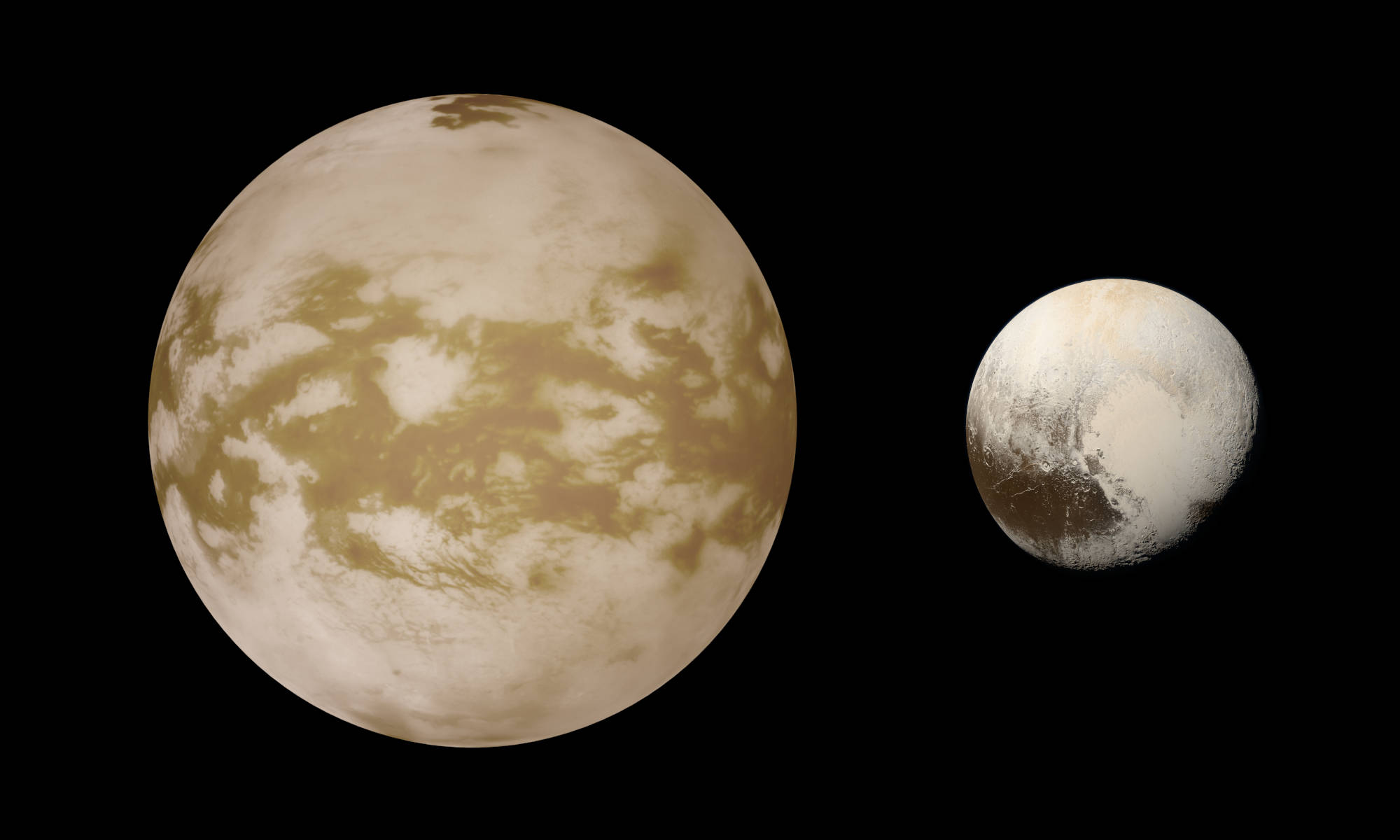
The image above reveals the disc of Titan as well as the disc of Pluto at scale. The view of Saturn's largest moon is based on near-infrared data obtained from the Cassini spacecraft during its long mission in the Saturn System. The original view of Pluto was obtained from the New Horizons spacecraft on July 14, 2015. The surface of Titan can't be discerned from outer space in the visible spectrum but it can be revealed in the near-infrared spectrum. Titan and Pluto look alike to a certain extent. Credit for the original texture of Titan: NASA/JPL-Caltech/University of Arizona. Credit for the original view of Pluto: NASA/Johns Hopkins University Applied Physics Laboratory/Southwest Research Institute/Alex Parker. Montage credit: Marc Lafferre, 2026. |
- To get further information on that news, go to: https://arxiv.org/abs/2606.13350 .